Lake Anna waterfront rules · Part 2 of 8
How Big a Dock Can You Build at Lake Anna?
Four separate limits apply to every dock on this lake, and the smallest one wins. Your frontage sets a ceiling. Your cove can lower it. Your side lines can lower it again. Height rules cap what you build on top.
In Part 1 we covered the thing most Lake Anna owners have backward: Dominion holds the shore land, and you are asking permission to build on it. Now for the question everybody actually wants answered.
How big a dock can you get? The number in your head is probably a square footage figure. The number that decides it is usually the width of your cove.
Read this as a starting point, not a rulebook. We put this together from Dominion Energy's published guidelines, the county ordinances and the state agency materials, and every source is linked in place so you can read the original yourself. The goal is to explain the questions we get asked most, in plain English, so you know what to expect and what to ask.
It is not a substitute for the actual rules or for an approval from anyone. Guidelines get revised, ordinances get amended, and every property on this lake is a little different. Before you spend money on drawings or a contractor, confirm what applies to your project with Dominion and your county. And if you find something here that has changed or that we got wrong, tell us and we will fix it.
Limit one is your frontage
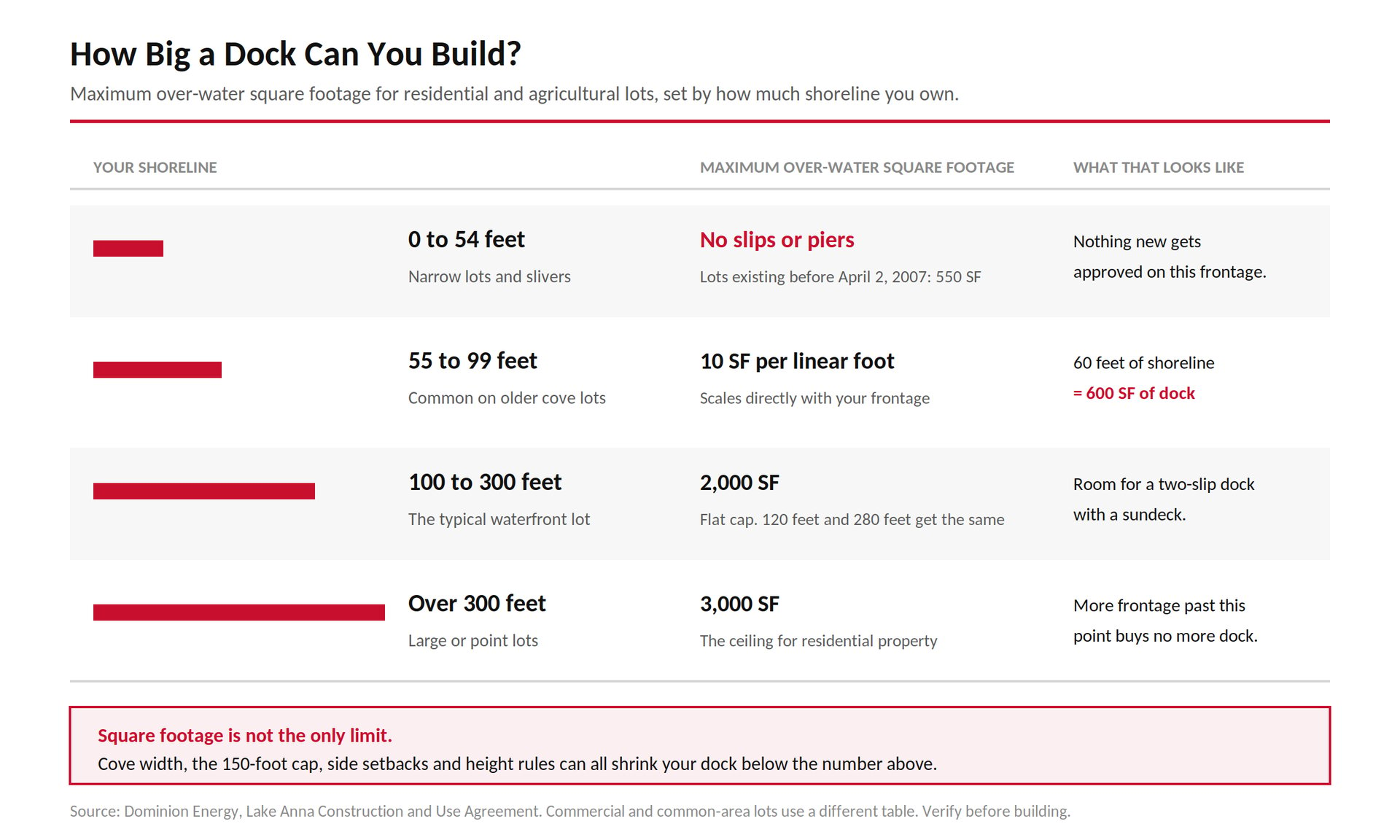
Dominion's Construction and Use Agreement sets a maximum over-water square footage based on how much shoreline you own. Four bands, and they behave differently from each other.
Under 55 feet
No slips or piers. The one exception is a parcel that existed before April 2, 2007, which is capped at 550 square feet. If you are looking at a narrow sliver lot, this is the first thing to check rather than the last.
55 to 99 feet
Ten square feet per linear foot of shoreline. This band scales directly, so 60 feet of frontage allows 600 square feet and 90 feet allows 900. Common on older cove lots, and enough for a single slip and a walkway.
100 to 300 feet
Two thousand square feet, flat. Not a per-foot calculation, which surprises people: 110 feet of frontage and 290 feet of frontage buy exactly the same dock. This is the typical Lake Anna waterfront lot, and 2,000 square feet is room for a two-slip dock with a sundeck.
Over 300 feet
Three thousand square feet, and that is the ceiling for residential property. Past 300 feet of frontage, more shoreline buys you no more dock. Worth knowing before you pay a premium for frontage you cannot use.
Commercial and common areas run on a different table. Ninety square feet per linear foot up to 99 feet, 75 per foot from 100 to 500, and 55 per foot above 500. If you are looking at a community common area or a commercial parcel rather than a private lot, those are your numbers.
Two lots on the same street make the point. One has 60 feet of frontage and gets 600 square feet. The neighbor has 140 feet and gets 2,000. The second owner has a two-slip dock with a sundeck, the first has a single slip and a walkway, and neither did anything wrong. Frontage decided it before either of them called a contractor.
Limit two is your cove, and it usually wins
This is the one that catches people, because it has nothing to do with the size of your lot.
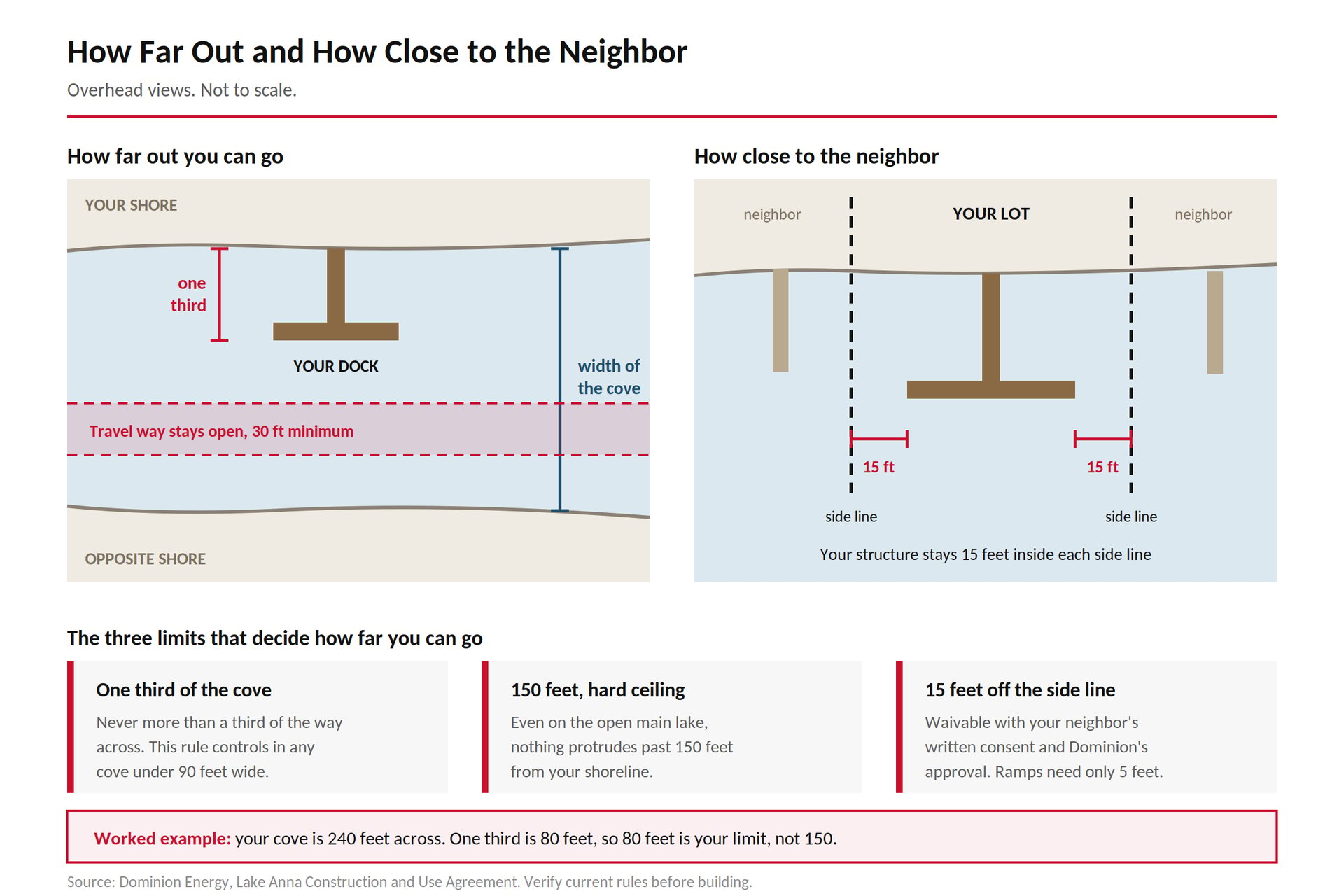
A structure may not protrude more than one third of the distance across a cove, up to a maximum of 150 feet.
Do the arithmetic and you can see which one binds you. One third of 450 feet is 150 feet, so on any cove narrower than about 450 feet across, the cove rule is your real limit and the 150-foot figure never comes into play. On most Lake Anna coves, the 150-foot ceiling is theoretical.
Worked example. Your cove measures 240 feet shore to shore. One third of that is 80 feet, so 80 feet is your limit, not 150. If the water is still shallow at 80 feet, that is simply the dock you get. Measure the cove before you sketch anything, and if you are buying, measure it before you fall in love with the lot. It is a five-minute exercise on a satellite image and it can change what a property is worth to you.
The rule also explains why your neighbor's dock across the water constrains yours. Two owners directly opposite each other in a narrow cove each build out one third, which leaves the middle third open. That open middle is the entire point.
Separately, Dominion requires water access entrances and travel ways into coves to stay at least 30 feet wide until the cove narrows to 90 feet or less.
Limit three is your side lines
Piers, floating docks and boat shelters must sit 15 feet off your side extension property line. Ramps only need 5 feet.
That 15-foot offset is waivable with your neighbor's written consent and Dominion's approval, which is one of the more useful facts in this whole series.
When the waiver is worth asking for. You and your neighbor both want your docks on the same side of your shared line, because that is where the deep water is. Fifteen feet each means 30 feet of dead water between you, sitting right over the best part of the cove. A signed letter from your neighbor plus Dominion's sign-off can collapse that gap. Ask for the letter before you pay for drawings, not after.
One related item: your side extension lines across Dominion's shore land are not always identical to the property lines on your plat. The notarized Recreational and Agricultural Rights certification in the application is where any difference gets sorted out, and your surveyor handles it as routine work.
Limit four is height and enclosure
- 20 feet for a flat roof, 28 feet for a pitched roof.
- Measured from lowest finished grade on land, and from normal lake level over water. Not from where the water happened to be the day your contractor walked the lot.
- A second story is allowed, but it may not be enclosed.
- Screened areas are not considered enclosed.
That screening distinction is worth repeating, because it is the difference between an upper deck you can actually use in July and one you cannot. Screen it and you are fine. Put walls and windows on it and you are not.
The county layer sits on top, and it differs by county
Everything above comes from Dominion and applies the same way on all three shorelines. Lake Anna touches Louisa, Spotsylvania and Orange, and your county adds a second layer on top of Dominion's rules. That layer is not the same in all three, and only one county has ever written dock standards of its own.
Louisa County
Louisa is the only one of the three with a dedicated Lake Anna shoreline ordinance. It has historically added its own standards on top of Dominion's: walkways capped at 5 feet wide, travel way between slip groups at least twice the slip length, and reflectors at least two inches in diameter at 10-foot intervals along over-water structures.
The Board of Supervisors voted in April 2024 to remove provisions that duplicated Dominion's review, and further changes have been discussed since. Meanwhile the PDF the county still posts online is the older 2015 text. We were not able to confirm from a primary county source exactly which of the standards above survived, so call Louisa Community Development and ask what is currently in force before you rely on any county dock standard.
Reflectors are the exception. The county still posts its reflector requirement as a live standalone document, so treat them as required. They are also cheap, visible, and a real safety item on a dark lake. Put them on regardless.
Spotsylvania County
Spotsylvania has no Lake Anna shoreline ordinance and sets no dock size standards of its own. Docks here run through the Chesapeake Bay Preservation Act program instead. The county treats docks and seawalls as water-dependent structures that can be allowed inside the 100-foot Resource Protection Area with a site plan and an approved Water Quality Impact Assessment.
Practically, that means the size and placement rules on this side of the lake are Dominion's, and the county review is about water quality and site impact rather than square footage.
Orange County
Orange holds the upper end of the lake and has no Lake Anna specific dock rules at all. Its zoning code does not address docks or piers, and Orange is not a Chesapeake Bay Act locality, so the Resource Protection Area framework that governs the Spotsylvania side does not apply either. Dominion's rules do essentially all the work here, with the county involved through its general permitting process. Confirm directly, because we could not retrieve Orange's dock permitting procedure from an official source.
The short version. Dominion's frontage table, the one-third cove rule, the 150-foot cap and the 15-foot setback apply wherever you are on Lake Anna. What changes with the county is the second layer: Louisa has written shoreline standards, Spotsylvania reviews under the Chesapeake Bay Act, and Orange has neither.
Boat lifts, sundecks and swim platforms
These are not named anywhere in Dominion's written guidelines, so in practice they fall under your square footage cap and the no-enclosure rule. Draw yours on the sketch when you apply and get it confirmed in writing. Then it is settled and on the record, and nobody has to reconstruct it years later.
Where to start
Measure your frontage and your cove before you talk to a builder. Those two numbers decide most of it, and both are free to get.
Then call the Reservoir Coordinator at Dominion's North Anna office before you pay for drawings. That office answers questions from property owners as a matter of routine, and fifteen minutes on the phone is worth more than any article, including this one.
Next in this series: why the dock stays with the house, what grandfathering protects when you want to add on, and why title never mentions any of it
Wondering what a specific lot will actually allow?
Frontage, cove width and setbacks decide what a waterfront lot is worth to you. We measure these before our clients write an offer. Reach out and let's talk about the property you have in mind.
[email protected]
www.themgroupva.com
[email protected]
www.themgroupva.com
Where this information came from. Every figure in this article was taken from primary sources and checked against them: Dominion Energy's published General Guidelines and Construction and Use Agreement for Lake Anna, Louisa County's shoreline regulations, and Spotsylvania and Orange County permitting materials, current as of September 2026. Each one is linked in place above so you can read the original rather than take our word for it. This is the best information we were able to find on the subject, assembled in one place because it is otherwise scattered across a Dominion packet and three county governments.
Where we are less certain, stated plainly. Two things in this article are softer than the rest and we would rather say so than let you find out later. First, Louisa County amended its shoreline ordinance in April 2024 and further changes have been discussed since, but the ordinance PDF the county still posts online is the older 2015 text. We could not confirm from a primary county source exactly which county dock standards survived that amendment, so treat anything in the county section as needing a phone call. Second, boat lifts, sundecks and swim platforms are not named anywhere in Dominion's published guidelines, so what we describe for those reflects common practice rather than written rule. Third, Louisa is the only one of the three counties with a Lake Anna shoreline ordinance. For the Spotsylvania and Orange sides we describe the framework each county uses, but neither publishes dock size standards, and we could not retrieve Orange's dock permitting procedure from an official source. If you own on those sides, confirm the county step directly.
Please verify before you build. Guidelines get revised, ordinances get amended, agencies update their forms and thresholds, and no article can keep pace with all of it. This one is intended to give you a starting point and a working understanding, not a final answer for your specific property. Confirm anything that applies to your project directly with Dominion Energy's Reservoir Coordinator at (540) 894-2307, and with your county: Louisa County Community Development at (540) 967-3430, the Spotsylvania County Division of Environmental Codes at (540) 507-7219, or Orange County Planning and Zoning at (540) 672-4347. They all answer questions from property owners as a matter of routine.
What we are and are not. The M Group is a real estate brokerage. We are not attorneys, engineers, surveyors or a permitting authority, and this article has not been reviewed or endorsed by Dominion Energy or any county. It is general information, not legal or engineering advice, and we make no warranty as to its accuracy or completeness or accept liability for decisions made in reliance on it. If you spot something that has changed or that we got wrong, email [email protected] and we will verify it and update the article. We would rather be corrected than be confidently wrong on a page people are using.
