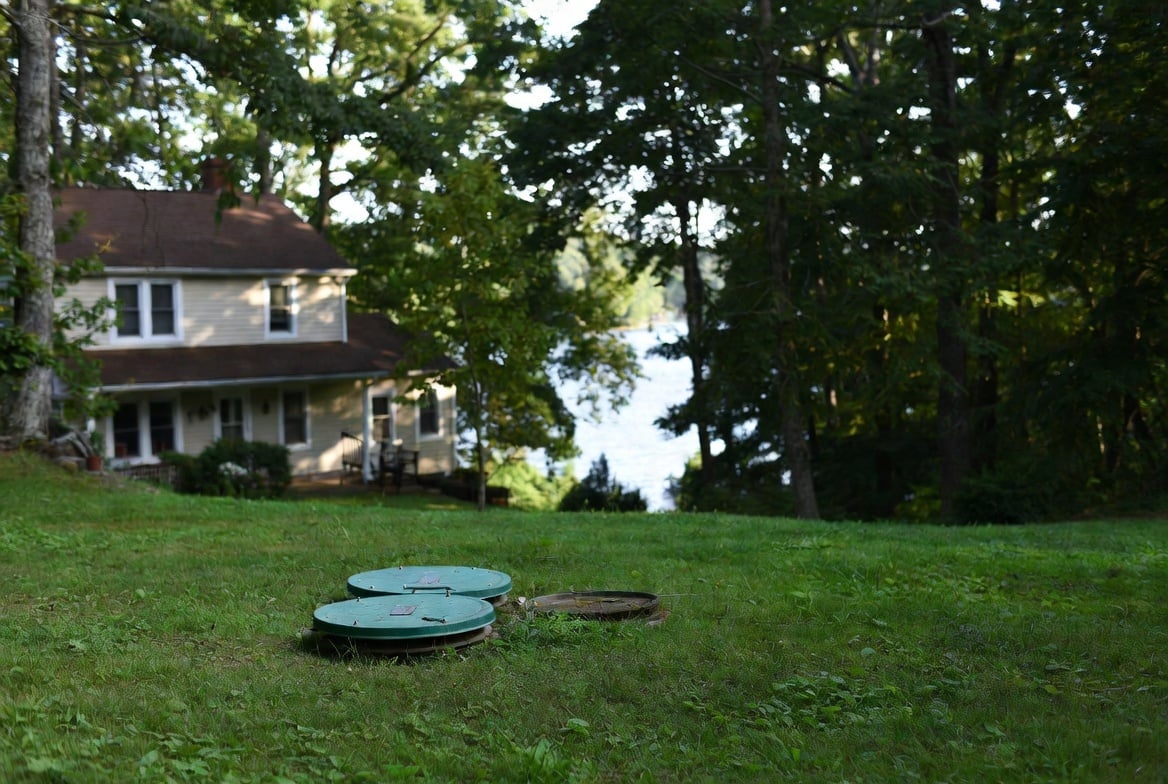
Most Lake Anna homes run on septic, and most buyers have never owned one. Here's how they actually work, the three types you'll find at the lake, what maintenance really costs, and the myths that refuse to die.
If you're moving to Lake Anna from the city or the suburbs, there's a decent chance you've never thought about what happens after you flush. Public sewer handled it. Out here, your property handles it, and the mystery of that little green lid in the yard makes more buyers nervous than almost anything else in a lake home purchase.
It shouldn't. A septic system is a simple, elegant piece of engineering that works quietly for decades when you understand it. So here's the plain-English version we give our buyers.
How a Septic System Works (In Actual Plain English)
A conventional septic system has four parts, and each one has one job:
The pipe from the house. Everything you flush or drain leaves through one main line. Simple.
The septic tank. A buried, watertight box, usually concrete, typically 1,000 gallons or more. Its job is to slow everything down. Solids sink to the bottom (that layer is called sludge), grease and soap float to the top (that's scum), and the liquid in the middle (effluent) flows out the far end. Bacteria living in the tank slowly digest what settles. Think of it as a settling pond with a cleanup crew.
The distribution box. A small junction that splits the outgoing liquid evenly among the drainfield lines. The unsung hero; when it tilts or clogs, one line gets everything and fails early.
The drainfield. Rows of perforated pipe buried in gravel trenches. The liquid trickles out and percolates down through the soil, and here's the part most people never learn: the soil is the real treatment plant. Billions of soil microbes finish cleaning the water before it rejoins the groundwater. The tank just does the prep work; the dirt does the magic.
That's it. No motor, no chemicals, no monthly bill. Gravity and biology.
The Three Types You'll Meet at Lake Anna
1. Conventional systems. Tank plus gravity drainfield, as described above. These need two things: decent soil that percolates, and enough suitable ground for the drainfield plus a reserve area. On larger wooded lots around Louisa and Spotsylvania, this is the workhorse.
2. Alternative systems (AOSS). Here's where the lake gets interesting. Waterfront lots are often small, close to the water, or sitting on soils that don't percolate well, so Virginia allows engineered "alternative onsite sewage systems" that add a treatment step before the soil: aerators, treatment units, pumps, sometimes a mound instead of buried trenches. They work beautifully, but Virginia law treats them differently: an AOSS must be checked once a year by a licensed operator, with a water sample every five years, and the state expects you to keep a maintenance contract. Budget roughly $200 to $700 a year depending on the technology. If you're buying a waterfront home at Lake Anna, there's a real chance it has an AOSS, and that annual contract simply comes with the lifestyle, like winterizing the boat.
3. Community systems and shared drainfields. Some Lake Anna communities took the drainfield off your lot entirely. Noah's Landing is the classic example: all 85 lots pipe their wastewater to community pumps and several shared mass drainfields, maintained by the property owners association and funded through the annual assessment. You still have responsibilities inside your lot line, but the drainfield is a community asset run like one. At the larger scale, Cutalong built actual wastewater treatment facilities, with treated water irrigating the golf course in season. When you buy in a community like this, the septic question becomes an HOA question: read the documents, understand what the assessment covers, and ask about the system's condition and reserves. We walk our buyers through exactly that.
The Maintenance Schedule, For Real
The EPA's guidance is refreshingly simple: have a conventional system inspected at least every three years and pumped every three to five years. Alternative systems get looked at every year (and in Virginia, for an AOSS, that's the law, not a suggestion). A pump-out at today's prices typically runs $250 to $700, with most standard tanks landing around $350 to $450. That's roughly $100 a year to protect a drainfield that costs five figures to replace. Cheapest insurance in homeownership.
One Lake Anna wrinkle worth knowing: the two sides of the lake play by different rules. Spotsylvania County is a Chesapeake Bay Preservation Act locality, so a pump-out at least every five years is mandatory there, with proof submitted to the county on a rotating schedule. Louisa County has no equivalent mandate, but the smart move is the same schedule regardless of which side of the lake you're on.
And if your lake home is a short-term rental, tighten all of it. A house that sleeps twelve every summer weekend is working its septic system far harder than the family it was designed for. Pump more often, and post simple "what not to flush" guidance for guests. Your drainfield will thank you.
Septic Myths, Busted
"The additive means I never have to pump." No product on a store shelf digests the sludge layer away. The bacteria are already in there, working for free. Nothing replaces pumping; some additives actually harm the system.
"It's not backing up, so it's fine." Backups are the last symptom, not the first. Trouble announces itself in the yard first: soggy spots or standing water over the drainfield, sewage odor outside, or drains that gurgle and run slow throughout the house.
"The grass is greener over the drainfield, so it's working great." Backwards, usually. A stripe of suspiciously lush, bright green grass over the lines in dry weather often means effluent is surfacing instead of soaking down. Even grass color is information.
"Flushable wipes are flushable." The most expensive lie in the plumbing aisle. Wipes, grease, coffee grounds, paint, and harsh chemicals either clog the system or kill the bacteria doing the work. The rule: nothing goes down that didn't pass through you or isn't toilet paper.
"The drainfield is just yard." Never park on it, drive on it, build over it, or plant trees near it. Compacted soil and invading roots are the two great drainfield killers. Grass is the only thing that belongs there.
"Septic systems are gross and smelly." A healthy system produces no odor you'll ever notice. If you smell it, it's telling you something. Call someone.
Why This Matters More at a Lake
Here's the part we care about as much as your resale value: every septic system around Lake Anna drains, eventually, toward the same watershed we all swim and fish in. Failing systems leak nutrients that feed the algae and aquatic weed problems this lake spends real money fighting. Maintaining your system isn't just protecting your drainfield; it's protecting the reason you bought here. Well-kept septic is lake stewardship.
Buying or Selling? Two Things Changed Recently
First: Virginia still does not require a septic inspection to sell a home. But as of July 1, 2025, when an inspection IS done, state law requires it be performed by a licensed onsite sewage professional, covering all accessible components, with a written report. The old quick-poke "rod and probe" inspection no longer counts. For buyers, that means the inspection you pay for actually tells you something now. For sellers, know this: deficiencies found in an inspection generally must be disclosed to future buyers unless they're fixed.
Second: if you buy a home with an AOSS, the maintenance obligations come with it from day one. That's not a reason to walk away from a great waterfront home; it's a line item to know about before you write the offer, and exactly the kind of thing we flag for our buyers early.
Your 60-Second Septic Checklist
Know where your tank and drainfield are (we can help you find the records). Pump every 3 to 5 years and keep the receipts. If it's an AOSS, keep the annual operator contract current. Keep vehicles, structures, and trees off the drainfield. Watch for wet spots, odors, slow drains, and that too-green stripe. And if you're on the Spotsylvania side, answer the county's pump-out notice when it comes.
Buying a lake home and want the septic records pulled and explained before you offer? Selling and wondering whether to inspect first? That's a normal part of how we work a Lake Anna transaction. Reach out at [email protected] or 540-870-0437, or start with our buyer's guide to Lake Anna. And for more owner know-how like this every week, subscribe to the Lake Life Briefing.
Sources include EPA SepticSmart guidance, Virginia's AOSS regulations (12VAC5-613), Spotsylvania County's Septic Pump Out Program, the Noah's Landing POA, and the Lake Anna Civic Association. Regulations and costs change; verify current requirements with your local health department. This article is general information, not engineering or legal advice.
