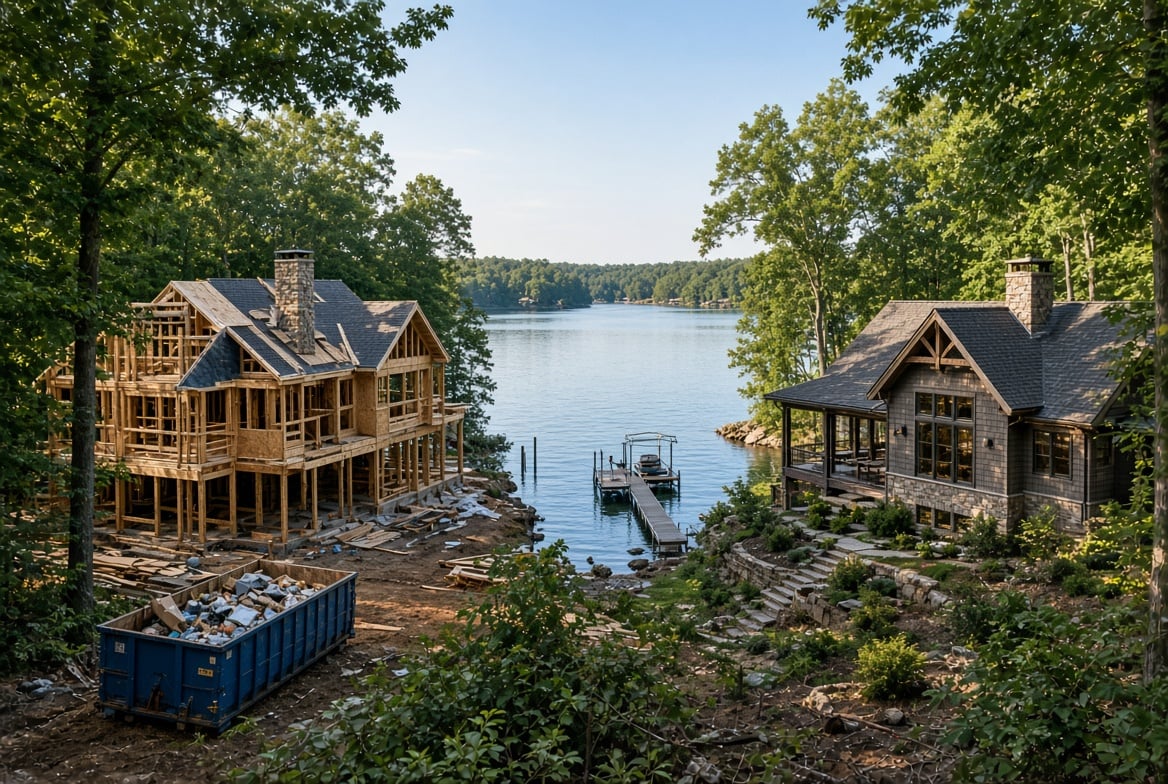
Forget the arguments at the HOA meeting. Follow the money instead. A year of MLS closings shows exactly where builders and big buyers are placing their bets at Lake Anna, and it's not subtle.
There are two conversations happening about short-term rentals at Lake Anna. One happens in community meetings and Facebook threads, and it runs on opinions. The other happens at closing tables, and it runs on wire transfers. We spent some time this week with the second conversation: every closed sale from the past 365 days in two of the lake's rental-friendly communities, pulled straight from the MLS. Money talks quietly, but it keeps very good records.
Our standing disclosure: The M Group works with investors, full-time residents, and everyone in between, and one of the sales in this data was our own listing. As always, we're not here to tell you what to think. We're here to show you what happened.
The Pattern: New Money Is Choosing Rental-Friendly Ground
Rock Island Landing and Elk Creek Landing are two of the lake's newest communities, both on the private side, and both allow short-term rentals. In the past 365 days, these two communities alone recorded 14 closed sales ranging from the high $500s to well over $3 million, including a $3.2 million custom waterfront build, a $2.6 million furnished waterfront sale, and a $3.9 million custom home recorded in January.
Look at who's doing the building and the picture sharpens. The homes sold in these communities over the past year came from a roll call of the region's active builders: Evergreene Homes, A&G Homes, Built Right Homes, RNS, and high-end custom builders, all choosing to put their spec capital, their models, and their marketing into communities where rentals are permitted. Builders are the most unsentimental market participants there are. They build where the buyers are, and right now they are building on rental-friendly ground.
The Tell Is in the Listing Copy
Here's our favorite piece of evidence, because nobody thinks of it as evidence: the way homes get advertised. Listing after listing in these communities says it outright. One Rock Island listing tells buyers "short term rentals are permitted" and calls the home "a great investment." Another touts "significant rental income" potential. An Elk Creek listing points out that "comparable waterfront homes at Lake Anna generate hundreds of thousands of dollars" in annual rental revenue. Two of the year's sales closed fully furnished, sold as operating vacation properties, right down to the decor.
Real estate agents advertise what buyers pay for, and only what buyers pay for. Nobody puts a feature in the first paragraph of a listing unless it moves the price. At Lake Anna in 2026, rental permission is a first-paragraph feature.
What Those Buyers Are Actually Paying For
Economists have a name for this: the option premium. When a buyer pays more for a home where renting is allowed, they're not necessarily planning to rent it. They're paying for the option, the knowledge that the income switch exists if life changes, and that the next buyer will value it too. The research on this is consistent. A study of Los Angeles-area rental restrictions found home values fell about 3% where the option was removed, and estimated rental potential had been priced into homes near the beach at roughly 10% of value. A New Orleans study concluded buyers price the option to rent into their offers even when they never use it. And closest to home, a 2025 study of coastal Virginia found short-term rental activity lifts nearby sale prices, with the effect strongest for higher-priced homes, which at a lake means the waterfront.
Lake Anna's own history fits the pattern. This is a market a national vacation-rental firm twice ranked the best place in America to buy a vacation home, with average gross rental revenues north of $80,000 a year. That income potential doesn't vanish when an owner chooses not to rent. It sits inside the price of every home that's allowed to earn it.
The Honest Other Side
Now the balance, because there is one. Some buyers want the opposite, and pay for it. A covenant that guarantees your neighbors are neighbors, not weekend guests, is itself a feature with a market. Restricted communities at the lake still sell well; in the same year of data, homes in one no-rental community sold in as little as 3 to 5 days, one over asking. Rules are not wrong. Rules are a trade, and both sides of the trade have a price.
We'll also be straight about what this data does not show. One year and a handful of communities can't prove that restricted homes sit longer or sell for less here, and we won't claim it until we've run the numbers on a much bigger sample, which we're assembling now. What this year's record does show, without ambiguity, is where new construction, top-dollar sales, and investment capital are concentrating, and it's in the communities that kept the option open.
What This Means for You
If you own in a rental-friendly community: your covenants are part of your property value, whether or not you ever host a guest. When you sell, that permission belongs in the first paragraph, priced accordingly. It's a question we handle in every listing strategy conversation.
If you're buying or investing: community rules are the first question at Lake Anna, before the granite and the dock. We keep current on which communities allow what, and it's step one of our buyer process.
If your community is debating restrictions: vote however your values point, but vote with open eyes. The market is telling everyone, through builder behavior, listing copy, and closing prices, that the rental option carries real value. Weigh that against what restrictions buy you in quiet and continuity, and decide what your community wants to be. For the fact-check on the claims usually driving these votes, see our companion piece on the five claims about Lake Anna renters.
We're building the larger dataset now, resales across a dozen communities, restricted and not, and we'll publish what it shows either way. To get it first, subscribe to the Lake Life Briefing. And if you want to know what your community's rules mean for your specific home's value, reach out at [email protected] or 540-870-0437.
Sources: Bright MLS closed sales, Rock Island Landing and Elk Creek Landing, trailing 365 days as of late August 2026 (deemed reliable, not guaranteed); Koster, van Ommeren and Volkhausen, Journal of Urban Economics (2021); Valentin, Real Estate Economics (2021); Safari, Zhang and Komarek, Annals of Regional Science (2025); Vacasa best-places rankings, 2021 and 2022. This article is general information, not investment advice.
