Lake Anna waterfront rules · Part 3 of 8
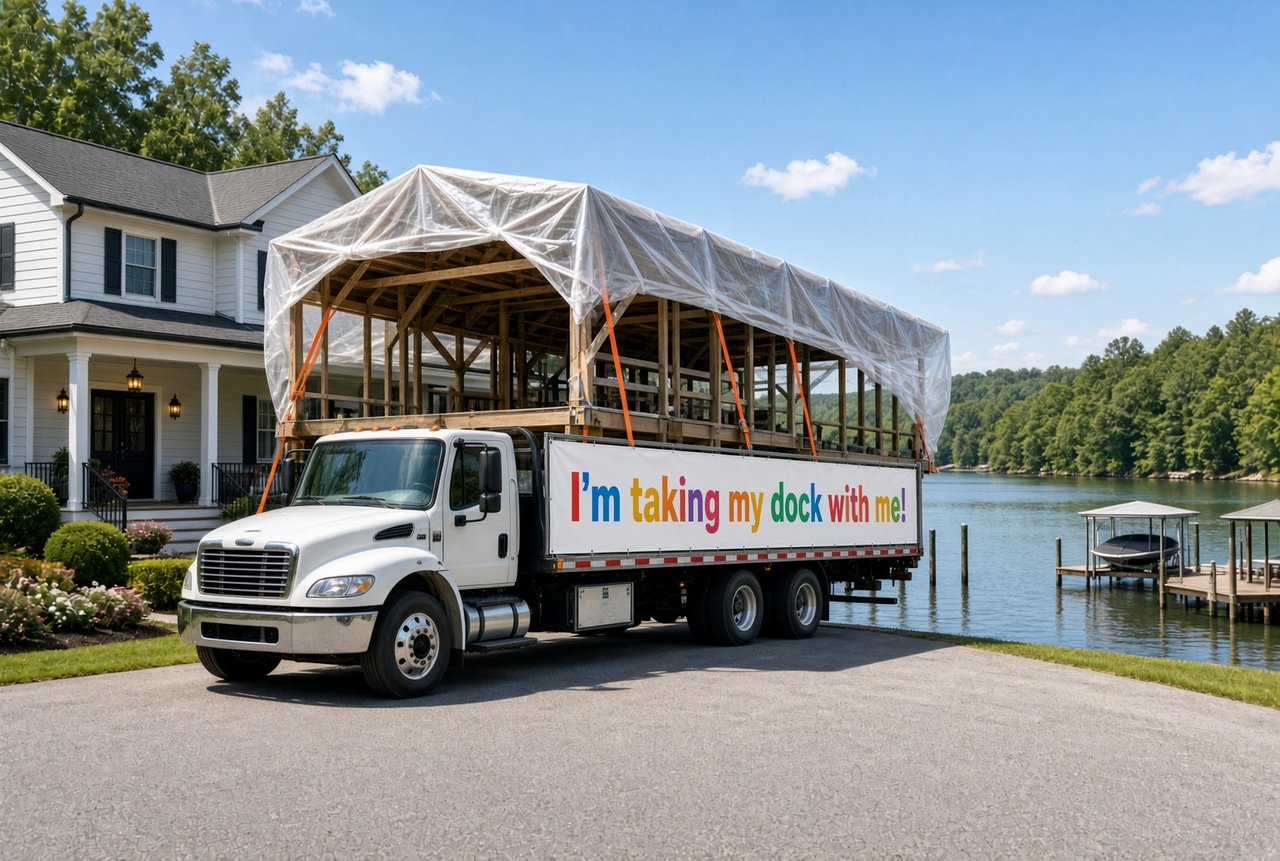
Does a Lake Anna Dock Convey With the House?
Yes. The dock stays, the buyer uses it, and there is no Dominion step at closing. The interesting part is why, because three separate things get called "the dock" and only one of them is what actually gives your property the right to be out there.
Part 2 covered building a dock from scratch. This part covers the far more common situation: there is already a dock there, and you want to change it, replace it, or buy the house it belongs to.
It also answers the question buyers ask us more than any other.
Read this as a starting point, not a rulebook. We put this together from Dominion Energy's published guidelines, the county ordinances and the state agency materials, and every source is linked in place so you can read the original yourself. The goal is to explain the questions we get asked most, in plain English, so you know what to expect and what to ask.
It is not a substitute for the actual rules, for an approval from anyone, or for legal advice on your specific transaction. Guidelines get revised, ordinances get amended, and every property on this lake is a little different. And if you find something here that has changed or that we got wrong, tell us and we will fix it.
Start with the short answer
When a Lake Anna waterfront home sells, the dock stays and the buyer uses it. That is how essentially every transaction on this lake works. There is no Dominion step at closing, nothing for your title company to clear, and no gap where you own a house you cannot walk out onto the water from. Buyers here get docks, and owners here get approvals to change them, all the time.
The reason it works so smoothly is worth understanding, because it explains a sentence in Dominion's guidelines that reads more alarming than it plays.

Three different things get called "the dock"
Separating them explains the whole subject.
Conveys automatically1. Your recorded R&A rights
Recreational and Agricultural rights across Dominion's shore land. This is a real property interest, it sits in your chain of title, and it runs with the land.
This is the thing that actually gives your property the right to have a dock in front of it. It is also what people mean when they say the dock conveys, and about that they are correct.
Does not convey2. The Construction and Use Agreement
Dominion's written permission to a named individual to place a structure on Dominion's land. A revocable personal license, not recorded in your chain of title.
Section I of the guidelines calls it "revocable and non-transferable to a new owner."
Stays with the house3. The physical dock
Lumber, pilings and a roof, sitting on land your neighbor Dominion happens to own. Nobody removes a dock at closing.
Number one does all the practical work. Number three stays put. Number two is the one that sounds heavier than it plays.
Dominion publishes no transfer form, no fee, no deadline and no closing step for Lake Anna. The words "sale," "closing," "buyer" and "purchaser" do not appear in the document at all. The recorded rights carry the load instead, which is exactly why sales here go through without anyone thinking about it.
Why your title company never mentions it
Agents ask us this one, and the answer is short: the dock is not on the parcel being conveyed.
A title search covers your parcel and what is recorded against it. The Construction and Use Agreement is neither. Your title company is not overlooking anything, it is simply outside what a title policy is for.
Dominion treats the two as separate too, which is the tell. The application asks for a notarized certification of your recorded rights, with a copy of your deed, before they grant the separate permission to build.
When the paperwork actually matters
The one moment it comes up is the first time a new owner wants to change something. Dominion works with whoever owns the property now, so when you apply to add a lift or rebuild a section, you are applying in your own name. That is a normal application, the same eight steps from Part 1, and people do it every season.
How it usually goes. You buy a house with a covered dock, and four years later you decide to add a boat lift. You put in an application, Dominion comes out and looks at the shoreline as they do on every application, and you get your approval. Having the seller's old sketch in your file makes that conversation shorter, because you can show what was already approved rather than reconstructing it.
Your county's role fits alongside this, and it differs depending on which of the three you are in. In Louisa, since the April 2024 amendment, the county confirms the Dominion agreement exists and matches the parcel, then defers to it. Deputy County Administrator Chris Coon put the county's position plainly: "If they have the approval from Dominion, we will take that as approval from Dominion to build there." In Spotsylvania, dock work runs through Chesapeake Bay Preservation Act review rather than a shoreline ordinance. Orange has no Lake Anna specific dock rules at all.
Two things worth doing at closing
Neither is urgent. Both make life easier later.
- Ask the seller for the signed Construction and Use Agreement and the approved sketch. File them with your deed and your survey. Whoever eventually applies to modify that dock will be glad to have them.
- Walk the dock with the sketch in hand. It should match. Docks get added to over the years, and it is easier to note a difference now than to reconstruct the history later.
That is the whole checklist. Older docks frequently have no paperwork on file anywhere, which is common and not a problem. It just means the next application starts from a fresh sketch.
What grandfathering protects, and why it depends on your county
Plenty of Lake Anna docks are older than the current rules and larger than those rules would allow today. What protects them is not the same on all three sides of the lake, and this is one of the few places in this series where the county genuinely changes the answer.
Start with the part that does not change: Dominion is the gatekeeper everywhere. The lake touches Louisa, Spotsylvania and Orange, but every dock on all three shorelines sits on Dominion's shore land and runs on a Construction and Use Agreement. County rules sit on top of that, and only one county's rules reach the dock itself.
Louisa County
Louisa is the only one of the three with a dedicated Lake Anna shoreline ordinance, and it is written to reach structures on Dominion's property specifically. Its definition of a structure includes docks, piers, boardwalks and slips on or attached to Dominion's land. So in Louisa you have a real, written county grandfathering rule for your dock.
What keeps a grandfathered dock grandfathered in Louisa
Louisa County shoreline ordinance, non-conforming structure provisions
What you do | What happens |
|---|---|
Leave it alone | Stays legal indefinitely, even if it is larger than today's frontage table allows |
Repair and maintain | The safe zone. Ordinary upkeep does not put the exemption at risk |
Expand it | An addition can bring the whole structure under current standards, not just the new part |
Rebuild within two years | Keeps the old footprint |
Rebuild after two years | Treated as new construction under current rules |
Spotsylvania County
Spotsylvania has no Lake Anna shoreline ordinance. Docks here are handled under the Chesapeake Bay Preservation Act program instead. The county treats docks and seawalls as water-dependent structures that can be allowed inside the 100-foot Resource Protection Area with a site plan and an approved Water Quality Impact Assessment.
Spotsylvania's general zoning code does contain non-conforming structure provisions, but they are written for buildings on your own parcel and are keyed to damage or abandonment rather than to voluntary removal. We could not find any source addressing whether they reach a dock sitting on Dominion's land. Call Environmental Codes and ask rather than assuming either way.
Orange County
Orange holds the upper end of the lake and has no Lake Anna specific dock rules at all. Its zoning code does not address docks or piers. Orange is also not a Chesapeake Bay Act locality, so the RPA framework that governs the Spotsylvania side does not apply. In practice that leaves Dominion's approval doing nearly all the work, with the county involved through its general permitting process. Confirm directly, because we could not retrieve Orange's dock permitting procedure from any official source.
The point that holds in all three counties. Dominion's agreement is revocable and non-transferable by its own terms, so county grandfathering never binds Dominion. However your county treats an older dock, Dominion's approval is the one that governs the structure. That cuts both ways: a county exemption is not a Dominion exemption, and a Dominion approval is what your county will ask to see.
So make the phone call before you draw anything. Say you have a 1990s dock that is generous by today's frontage table and you want to add a lift and a sundeck. Sometimes the answer is fine and you build it. Sometimes you learn it is smarter to do the lift and skip the sundeck. Either way you find out in ten minutes rather than after you have paid for drawings.
How to amend an existing agreement
Dominion's amendment process is lighter than a new application. You submit the same two sketches described in the initial-steps procedure, generally without the notarized R&A certification unless they tell you otherwise.
The sketches need to show what they always show: overall dimensions, distance to the nearest structures left and right, shoreline to opposing shoreline distance, and the distance from your outermost structure to the opposing shoreline.
Show the change clearly. If you are adding a lift, draw the lift. If you are extending a walkway, draw the new length and the new total. And if your dock has changed since the original drawing, sketch it as it stands today rather than as it was first approved. The site visit is going to see the current version anyway, so a sketch that matches saves everyone a round trip.
Buying? Five questions for your due diligence period
- Is there a signed Construction and Use Agreement, and can I see it? If the seller cannot produce one, that is information rather than a problem. Older docks frequently have nothing on file anywhere.
- Does the approved sketch match what is on the water today? Walk the dock with the sketch in hand. Highest-value ten minutes in the whole transaction.
- Does everything out there appear on that sketch? Part 4 of this series covers what Dominion does and does not allow on a dock, so you know what you are looking at.
- What is the frontage, and what does the current table allow? If the existing dock is larger than today's table, it is an older structure that stays as it is. Just know it going in, so you can plan around it if you have expansion in mind, and note that how it is treated depends on which of the three counties you are in.
- What is the cove width? That governs anything you might want to build later, and it is a five-minute check on a satellite image.
Where to start
If you are buying, ask for the agreement and the sketch during due diligence and file them with your closing documents. If you already own and you are thinking about adding on, call the Reservoir Coordinator at Dominion's North Anna office before you pay for drawings. That office answers questions from property owners as a matter of routine.
Next in this series: what you can and cannot put on a Lake Anna dock , including the surprisingly common question about running power and water out to the water's edge
Buying or selling waterfront at Lake Anna?
Knowing how the dock paperwork works makes a waterfront transaction smoother for everyone at the table. We handle these details on every deal. Reach out and let's talk about your property.
[email protected]
www.themgroupva.com
[email protected]
www.themgroupva.com
Where this information came from. Every statement in this article was taken from primary sources and checked against them: Dominion Energy's published General Guidelines and Construction and Use Agreement for Lake Anna, Louisa County's shoreline regulations, and reporting on the county's April 2024 ordinance amendment, current as of September 2026. Sources are linked in place above so you can read the originals rather than take our word for it. This is the best information we were able to find on the subject, assembled in one place because it is otherwise scattered across a Dominion packet and three county governments.
Where we are less certain, stated plainly. Three things in this article are softer than the rest. First, we verified that Dominion publishes no transfer process, form, fee or deadline for Lake Anna, and the non-transferability language we quote is accurate and current, but we could not confirm whether the North Anna reservoir office would accept or expect a transfer application if a new owner submitted one. Second, Louisa County amended its shoreline ordinance in April 2024 and the ordinance PDF the county still posts online is the older 2015 text, so confirm the non-conforming provisions with Community Development rather than relying on the posted version. Third, and most relevant to the county section above: Louisa is the only one of the three counties with a Lake Anna shoreline ordinance, and it is the only one whose non-conforming rule is written to reach a structure on Dominion's land. Spotsylvania and Orange have general zoning non-conforming provisions, but we could not find any source addressing whether those reach a dock that sits on Dominion's property rather than on your parcel. If you own on the Spotsylvania or Orange side and this matters to your project, ask the county directly rather than relying on the Louisa framework.
Please verify before you act on it. Guidelines get revised, ordinances get amended, and no article keeps pace with all of it. This one is intended to give you a starting point and a working understanding, not a final answer for your property or your transaction. Confirm anything that applies to you directly with Dominion Energy's Reservoir Coordinator at (540) 894-2307 or [email protected], and with your county: Louisa County Community Development at (540) 967-3430, Spotsylvania County Division of Environmental Codes at (540) 507-7219, or Orange County Planning and Zoning at (540) 672-4347.
What we are and are not. The M Group is a real estate brokerage. We are not attorneys, title agents, engineers or a permitting authority, and this article has not been reviewed or endorsed by Dominion Energy or any county. What a buyer owns after closing is a legal question, and nothing here is a legal opinion or a title opinion on any specific transaction. Bring those questions to your closing attorney. We make no warranty as to accuracy or completeness and accept no liability for decisions made in reliance on this article. If you spot something that has changed or that we got wrong, email [email protected] and we will verify it and update the article.
