Bolt's Corner · Lake dogs
Everyone around here says the same two things: the lake is fine to swim in, and you don't drink it. We went looking for whether that holds up, and whether any animal has actually gotten sick from Lake Anna water.
Short answer: the local wisdom is right, and the record is better than the lake's reputation. Virginia has never recorded an algae toxin sample here above the level that triggers an advisory, in any year, and we could not find a single documented case of an animal getting sick from Lake Anna water. Read that zero as a floor rather than a fact, because nobody is required to report a sick dog and nobody keeps a list. Swimming is not the problem. Drinking is, and the realistic outcome of a dog drinking lake water is a few days of diarrhea rather than anything dramatic. The two things most worth your attention are a towel and one vaccine decision.
What the record actually says about this lake
We wanted the real answer rather than the one everybody repeats, so we went looking for it.
Lake Anna gets written about for harmful algae, so start there, and start with two words that get used as though they mean the same thing. They do not: algae and toxin.
Cyanobacteria is blue-green algae. It lives in every freshwater lake all the time, in small amounts, and it is a bacteria rather than a plant. Give it warm, still, nutrient-rich water and it multiplies into what people call a bloom. Cyanotoxins are the poisons that some of those species produce, some of the time, as they grow. So a lake can be full of algae and carry almost no poison, or carry poison without looking like much. The algae is not the hazard. The toxin that some of it sometimes makes is.
The Virginia Department of Health has posted swimming advisories here in most summers since 2018. The worst was 2021, at 123 days out of a 184-day season. An advisory is not a closure: it is the health department telling people to stay out of the water in a specific posted area, and at this lake those areas have been the upper branches rather than the whole thing. Still, that is a real record, and it is why the lake has the reputation it has.
Here is the part almost nobody knows. Those advisories were triggered by cell counts, meaning how much algae was in the water, not by how much poison was in it. Across every one of those years, no Lake Anna sample has ever contained an algae toxin above the level that triggers an advisory. Not one. The lake grew plenty of algae and almost no poison, year after year.
That gap between algae and poison is exactly why the health department stopped using cell counts as the trigger in February 2025 and now goes by toxin levels alone. Under that newer standard there has been no advisory here in 2025 or 2026, which is not surprising, because toxins never crossed the line under the old standard either. A 19-month US Geological Survey study of the upper lake found toxins present but every single measurement below 0.65 micrograms per liter, against an advisory threshold of 8 micrograms per liter.
Those numbers mean nothing until you put them somewhere. A microgram per liter is one part per billion. Picture a 20,000 gallon backyard pool: the level at which Virginia posts an advisory works out to about a dozen drops of toxin in the whole pool, and the highest reading anywhere in that study was about one drop. One honest note on that threshold. It was written for people swimming, not for a dog drinking, and no agency publishes a number for that. So treat the 8 as a human yardstick that happens to be the only one anybody has.
Now the part that matters most for a dog. We found no documented report of any dog, cat or livestock becoming ill or dying after exposure to Lake Anna water. Not confirmed, not suspected, not alleged. We went through state health department releases, Department of Environmental Quality records, the Lake Anna Advisory Committee's reports, the Lake Anna Civic Association's water quality archive, the Geological Survey study and a decade of local news. The dog deaths people attach to this lake in conversation happened somewhere else. The most widely shared case involves a couple in Wilmington, North Carolina, who lost three dogs to a backyard pond in 2019.
What "no reported cases" does and does not mean
Now the caveat, because we would rather say it than let you treat that zero as a guarantee. Everything above comes from what gets officially reported, and that is narrower than what happens.
The sampling is thin to begin with. It happens on the public side, upstream of the Route 208 bridge, between May and October, and mostly in response to somebody calling in a bloom rather than on a set schedule. The private side, the warmer water on the Dominion cooling side, has almost no published data at all.
The bigger gap is this. Nobody keeps a list of dogs that got sick at a lake. No registry, no requirement to report one, and nothing that connects a vet visit in Louisa County to any state database. A dog with three days of diarrhea after a swim never gets counted anywhere. The agencies say so themselves. The CDC takes animal reports voluntarily from about fifteen states and states plainly that its counts are undercounts, and the only comprehensive review of dog poisonings in this country concluded that most cases are never reported and often never even recognized by owners or their vets. That is not a knock on anyone. It is how the system is built, and it means records only show what somebody wrote down.
Things circulate in this lake's Facebook groups that never reach an agency, and some of those are real. We write from what can be verified because it is the only honest thing to write from. But we do not know the real number of dogs that have gotten sick at this lake. We know it is not provably zero, because zero is only what the records hold. Both possibilities lead to the same advice: the precautions below are free, you do not need proof that something happened here to put a bowl of water on the dock, and when it is your dog or your kid, err toward caution rather than toward whatever the records happen to show.
So why does everyone say don't drink it?
Because swimming and drinking are not the same exposure. EPA's measured figures put accidental swallowing during a swim at about 16 milliliters for an adult and 37 for a child, which is one to two and a half tablespoons. A dog standing at the edge drinking takes in a liter or more, about a quart, a big sports bottle. Twenty to sixty times as much.
Then there is where they drink. Wind pushes algae to the downwind shoreline and piles it up. In studies on other lakes, and nobody has measured this at Lake Anna, toxin at that edge ran a hundred to a thousand times higher than out in open water. That multiplier matters, because the reassuring numbers further up came from open water. It is also the reason the thing to manage is the shoreline rather than the lake. A swimmer is out in the middle. A dog drinking is in the exact spot where everything collects.
Virginia's health department words it almost the way your neighbor does: swimming is generally acceptable in natural water, but natural water is not disinfected, and never swallow it. The lake is not toxic. The lake is untreated. The whole thing lives in that difference.
Why the rules are different for a dog
Dogs drink while they swim. They lap at the shoreline where the scum is. They lick their coat dry, which turns something that was on them into something in them. They eat dried algae mats and dead fish off the bank. They are smaller, so the same swallow counts for more.
And the one that matters most: a dog cannot read the water or the sign. You look at a cove gone the color of pea soup and decide against it.
What separates you from your dog here is behavior, not biology, and that is the good news for the kids on your dock. A child does not drink from the lake on purpose, lick themselves dry, or eat what washed up. A dog does all three.
What actually happens, in order of how likely it is
Most likely, and least dramatic: an upset stomach. Giardia, a gut parasite that lives in surface water, turns up in about 8 percent of US dogs, and most infections cause no signs at all. A dog that habitually drinks lake water will probably meet it or its cousin Cryptosporidium eventually, and the honest outcome is usually nothing, or a few days of diarrhea a vet clears up without much trouble. A laundry problem far more often than a tragedy.
Just as likely, easier to prevent: an ear infection. Up to one dog in seven develops one in its lifetime and moisture from swimming is a named cause. If you own a Lab, a golden, a spaniel or anything with a heavy ear, this is the one actually coming for you.
Uncommon, serious, and worth an actual conversation: leptospirosis. It spreads through wildlife urine, especially raccoons, into standing and slow-moving water, and gets in through the mouth, the eyes or a break in the skin. It can reach irreversible kidney failure within days, and it is one of the few things here that can also infect a person. In a study across Virginia and North Carolina, about 10.8 percent of unvaccinated dogs had antibodies for it in their blood, meaning they had met the bacteria at some point. Most of them never got sick from it.
There is a vaccine, and rather than tell you to go get one, here is what it is and what the argument around it actually looks like.
A vaccine shows the immune system a weakened or harmless piece of a germ so the body builds its defense in advance, before it meets the real thing. Leptospirosis comes in many strains, and that defense only works against the strains in the shot. The US vaccines cover four of them. In that same Virginia and North Carolina study, the two strains showing up most often were not among the four. So it is solid protection against four strains and no protection against the rest, which is a real but partial thing rather than a wall.
The profession does not fully agree on this one either, which is worth knowing before anyone tells you it is settled. In 2024 the American Animal Hospital Association moved it from optional onto the list it recommends for every dog. The global body, WSAVA, kept it on that list only in places where the disease is common and left the call to the individual vet. The vaccine also picked up a reputation for bad reactions in small breeds, which the group that reclassified it says newer safety data does not back up. And immunity runs about twelve months, so it means a shot every year rather than once.
Our view, for what it is worth. The question is not whether vaccines are good or bad in general. It is whether this dog's exposure is high enough to make this particular vaccine worth giving. A dog that swims the lake all summer and shares a shoreline with raccoons is at the high end of that. A dog that visits twice a year and stays on the dock is not. That is a conversation about your animal, and if a vet recommends it without asking how your dog actually spends its time, ask them that question yourself.
Rare and severe: algae toxin poisoning. The CDC logged 20 dog illnesses nationally in 2022 and 48 in 2021. The real number is higher and nobody knows by how much, but it is nothing like the hundreds a year that get claimed online.
Since nobody ever spells out what it actually does, here it is. There are two families of these toxins and they look nothing alike. The nerve toxins work in minutes: tremors, stumbling, rigid muscles, labored breathing, seizures in a dog with no history of them, collapse. The American Veterinary Medical Association notes that many cases of this kind are fatal within the hour. The liver toxins take hours to days and open with vomiting, diarrhea, drooling and lethargy before the telling sign, jaundice, meaning yellow gums or yellow in the whites of the eyes. There is no antidote to either. Treatment is supportive care, which means fluids, oxygen and monitoring while the dog's body clears the toxin on its own, and it works far better early than late.
One honest thing about appearance, because it cuts both ways. Most blooms are not toxic and you cannot tell which is which by looking, and water can look perfectly clean and still carry a problem because some species never form scum at all. So looking at the water cannot tell you it is safe, and it cannot tell you it is dangerous either. Green scum is a reason to keep the dog out of that spot rather than proof of poison, and clean-looking water is not permission to let them drink.
Five things that cost nothing
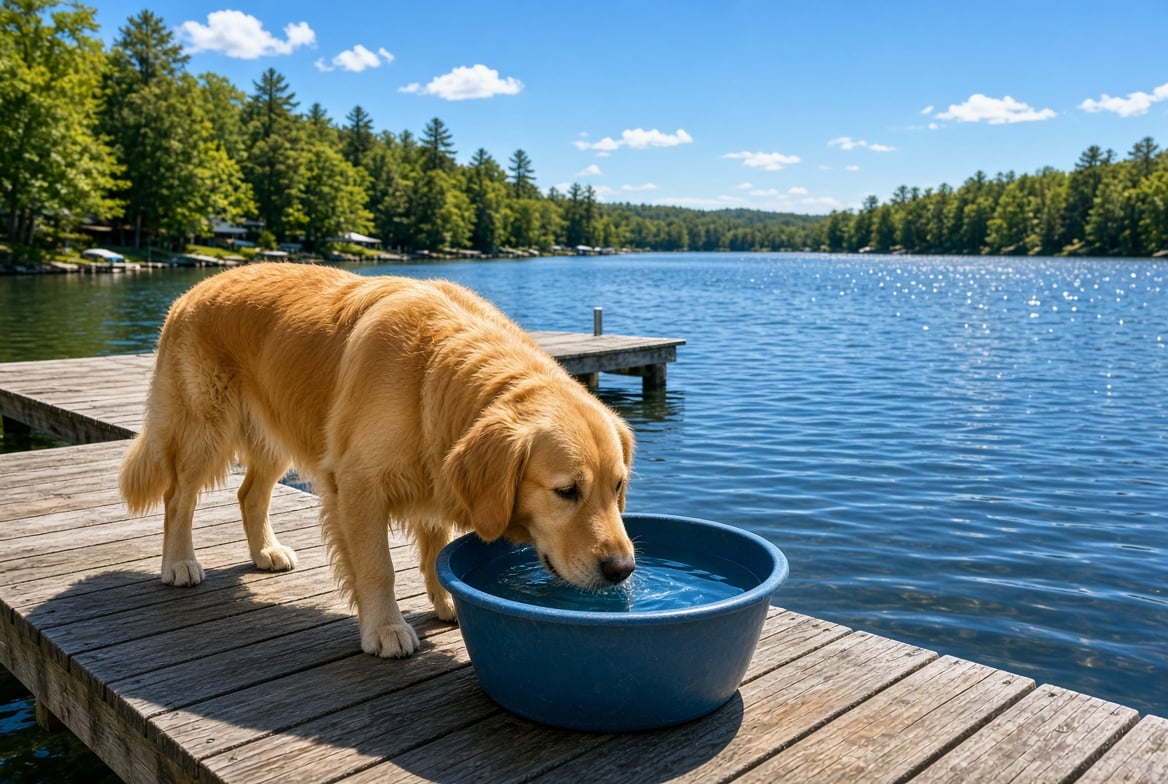
- Keep a bowl of fresh water on the dock and offer it often. This is the whole ballgame. It removes the reason to drink from the lake rather than asking you to stop a thirsty dog mid-swim. What goes in the bowl is its own question, which matters here because every house on this lake is on a well, and we went through the evidence on it in Reverse Osmosis Water for Dogs.
- Rinse the dog off before they lick themselves dry. A hose at the dock does it, and it turns a coat exposure into nothing.
- Dry the ears. Thirty seconds with a towel, every time. Highest payoff per second in this column.
- Swim in open water, and stay out of the stagnant cove and the scummy downwind edge. That is where a dog drinks the most and where the algae is most concentrated.
- Wait three days after a heavy rain before letting the dog swim. Runoff is what feeds a bloom, and that is the health department's own guidance. Before a holiday weekend, check their harmful algal bloom dashboard for current status.
Those five are free and none of them is a judgment call. The leptospirosis vaccine is the one that is, so weigh it against how your dog actually uses the water.
If you think your dog drank something bad
Go now, even if the dog seems completely fine. That is the actual guidance, and the CDC puts the reason starkly: a dog can swallow almost enough of this toxin to kill it and still look and act completely normal. Looking fine is not information. The window in which a vet can still get the toxin out of the dog is roughly the first hour.
Rinse the dog with clean water if they are not in distress, and if they are, skip it and drive. Photograph the water on the way out so your vet can see what the dog was in. Do not try to make the dog vomit at home, and do not bother boiling or filtering lake water, because neither removes these toxins. Call ahead so they are ready for you. ASPCA Animal Poison Control is 888-426-4435 and the Pet Poison Helpline is 855-764-7661, both around the clock, and both charge a consultation fee.
Frequently asked questions
Is it safe for dogs to swim in Lake Anna?
Generally yes, and the record supports it. No Lake Anna sample has ever contained an algae toxin above Virginia's advisory threshold, and there is no documented case of an animal becoming ill from Lake Anna water. Swimming puts very little water inside a dog. The caution is about drinking, about the scummy downwind edge of a stagnant cove, and about rinsing the dog off afterward before they lick their coat dry.
What does blue-green algae poisoning look like in a dog?
Two different pictures. The nerve toxins act within minutes and look like muscle tremors, stumbling, rigid muscles, labored breathing, seizures in a dog that has never had one, or collapse. The liver toxins take hours to days and start with vomiting, diarrhea, drooling and lethargy, then jaundice, meaning yellow gums or yellow in the whites of the eyes. There is no antidote to either, treatment is supportive care, and it works far better the earlier it starts. Any of those signs after a swim is an emergency visit, not a wait-and-see.
Has a dog ever gotten sick or died from Lake Anna water?
We could not find a single documented case, confirmed or suspected, in state health or environmental records, Lake Anna Advisory Committee reports, the civic association's water quality archive, a US Geological Survey study of the lake, or a decade of local news. The widely shared dog deaths people associate with this subject happened elsewhere, most famously to a family in Wilmington, North Carolina in 2019. Read that zero as a floor rather than a fact: nobody is required to report a sick dog, no registry exists, and the CDC says its own national animal counts are undercounts. No record of something is not the same as it never happening.
What happens if my dog drinks lake water?
Most often nothing, and the next most likely outcome is a few days of diarrhea from Giardia or Cryptosporidium, both gut parasites found in surface water, which a vet treats routinely. The rare and serious outcome is algae toxin poisoning, which is fast and has no antidote but is concentrated in visible blooms and shoreline scum. The practical answer is to keep fresh water on the dock so the lake is never the most convenient drink.
Should my lake dog get the leptospirosis vaccine?
That depends on exposure, and the profession is not unanimous. In 2024 the American Animal Hospital Association moved it from optional onto the list it recommends for every dog, while WSAVA keeps it there only where the disease is common and leaves the call to the individual vet. It protects against four strains and not the others, immunity lasts about twelve months so it means an annual shot, and in one Virginia and North Carolina study about one unvaccinated dog in nine already had antibodies for it. A dog that swims all summer and shares a shoreline with raccoons has far more exposure than one that visits twice a year. Take the exposure question to your vet rather than treating it as automatic either way.
Where we landed
None of this is really about the lake. It is about the edge of the lake and the hour after the swim. A bowl on the dock, a hose rinse, a towel in the ears, open water instead of the green cove, and three days after a hard rain. That is a couple of minutes and no money, it covers most of what could realistically go wrong, and none of it involves keeping your dog out of the lake.
Ours would have swum every day of his life if we let him. Go let yours swim.
Please verify before you act on it. This reflects our research as of November 2026, from the Virginia Department of Health, Virginia DEQ, USGS, CDC, AVMA, AAHA, EPA, Cornell's Riney Canine Health Center, the Virginia-Maryland College of Veterinary Medicine, the Lake Anna Advisory Committee and the Lake Anna Civic Association. Virginia's advisory season runs May 1 to October 31, so check VDH's harmful algal bloom dashboard or call 1-888-238-6154 for current status before a summer weekend. "No documented case" means none we could find in the public record, not a guarantee. We are real estate agents, not veterinarians: anything about your specific dog is a conversation for your vet.
What we are and are not. The M Group is a real estate team with REAL Broker. We are not veterinarians, physicians, toxicologists or a public health agency. Nothing here is veterinary or medical advice, no agency named has reviewed or endorsed it, and we disclaim warranties and liability for decisions made from it. It is a starting point for better questions and a better conversation with your vet.
Looking at waterfront with a dog in the truck?
Send us the address and we will tell you what we know about that cove: how the water moves, whether it is the kind of still back-of-the-cove spot that goes green in August, and where the dog would actually get in and out.
Talk to us about buying at Lake Anna, or get a straight answer on what your waterfront is worth.
We are on this water every week and we are happy to answer a question without a listing attached to it.
Michael Boyce II, Real Estate Professional
The M Group, Real Broker, LLC
540-870-0437
[email protected]
www.themgroupva.com
Melanie Lucero, Real Estate Professional
The M Group, Real Broker, LLC
540-870-0714
[email protected]
www.themgroupva.com
Bolt's Corner
For Our Best Buddy, Bolt
Reverse Osmosis Water for Dogs: What the Evidence Shows
Swim Yes, Drink No: Lake Anna Water and Your Dog (this article)
Want the lake in your inbox? The Lake Life Briefing goes out weekly with lake levels, what is happening around the water, and new listings. Sign up here.
