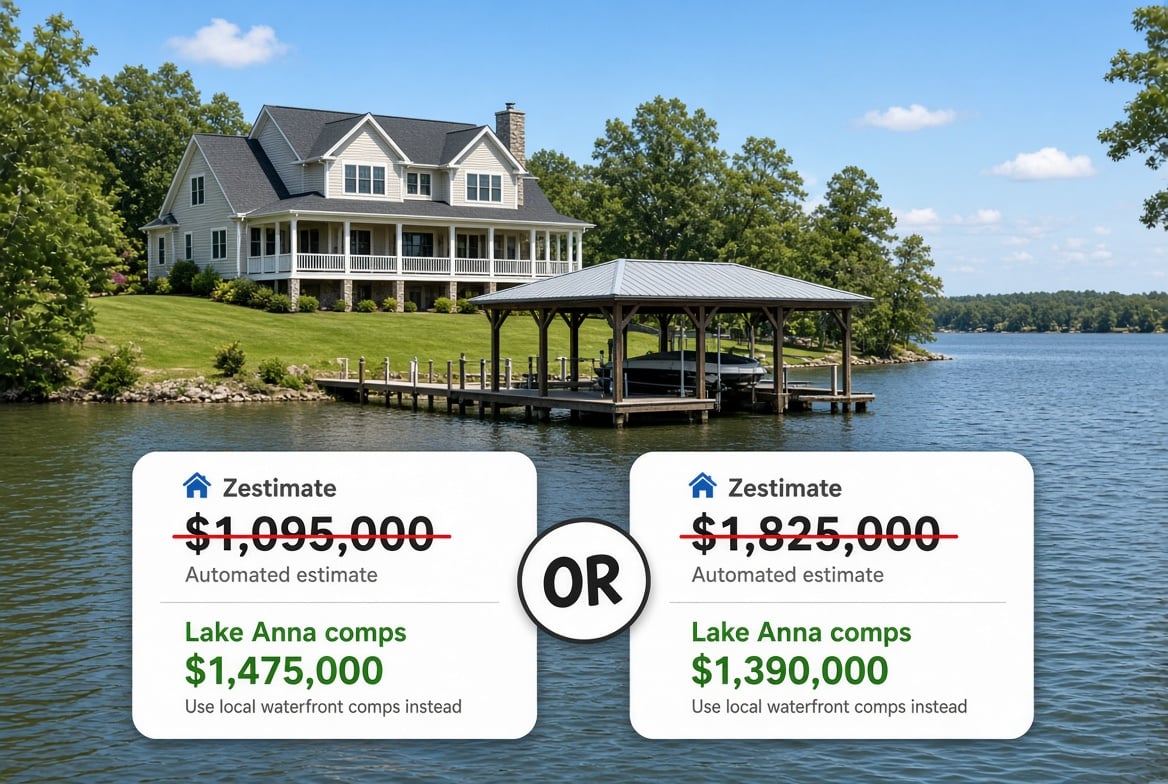
Why Your Zestimate Is Wrong on Waterfront, and What Number to Use Instead
You looked up your address, saw a number, and now you cannot unsee it. Maybe it was $200,000 higher than you expected and you started planning around it. Maybe it was $200,000 lower and it ruined your week.
Either way, that number was produced by a model that has never seen your water. On waterfront at Lake Anna, that is not a small gap. It is the difference between the two most expensive facts about your property and a guess built from the houses behind you.
What an automated value actually does
An automated valuation model is a statistics engine. It pulls public tax records, recorded sales, and listing data, then finds patterns: square footage, bedroom and bath count, lot size, year built, and recent sale prices nearby. It fits those patterns to your address and prints a figure.
That works reasonably well in a subdivision where 400 houses were built by the same three builders on the same size lots. There is enough repetition for the math to learn from, and the houses really are close to interchangeable.
Lake Anna is the opposite of that. Roughly 13,000 acres and about 200 miles of shoreline across Louisa, Spotsylvania, and Orange counties, and almost none of it repeats. The model is being asked to price a one-off from a data set built for tract housing.
The two facts it cannot see at all
Which side of the lake you are on. The private side, the warm side, is the Dominion Energy cooling lagoon serving North Anna, restricted to property owners and their guests, with no public ramps. The public side is larger, open, with marinas and public access. Those are functionally two different markets, and they routinely price six figures apart on otherwise comparable homes.
There is no field in a tax record for that. The model sees a parcel in Louisa County, not a parcel on the warm side of a private lagoon. If it is averaging both sides of the water together, and most of them effectively are, your number is being pulled toward a middle that does not exist for either group of buyers.
Depth at your dock, especially at winter drawdown. This is the most underweighted value driver on the lake and the one buyers care most about once they have looked at four or five properties. A house with water that holds a boat all year and a house that sits on mud in February are not the same product at any price.
No public record contains that number. No model has it. Buyers absolutely have it, because the good ones walk out to the end and ask.
The comp problem is worse than the data problem
Even setting aside what the model cannot see, it does not have enough to work with.
A statistical model needs volume. Coves at Lake Anna can go a long stretch without a sale, and when one happens it may be the only true comparable within miles. So the model widens its net, and the net catches off-water homes, water access homes, and subdivision sales that have nothing to do with your shoreline. Every one of those pulls your figure toward a number that has no water in it.
This is the same reason pricing waterfront by hand takes real work. The comps have to be found, adjusted, and in some cases discarded. A model does not discard. It averages.
Listing data adds its own noise. "Waterfront," "water access," and "water view" get used loosely, and once a water access sale is absorbed as a waterfront comp, the error spreads to every property the model prices off of it.
Your county record is probably wrong too
Almost every lake house we walk into has something the record card does not know about. A finished basement carried as unfinished. An addition or sunroom that never made it onto the sketch. A boathouse, a lift, or a second slip. A garage converted years ago.
Add three counties with their own assessment cycles and their own record quality, plus wells and septic instead of municipal water and sewer on most of the lake, and the input side is shaky before the math even starts.
Garbage in is not a cliche here. It is the mechanism.
The confidence range nobody reads
Most automated values publish an accuracy range in the fine print. Almost nobody clicks it.
On a property in the range where Lake Anna waterfront generally trades, roughly $750K to $2M and up, even a modest published error band covers a spread wide enough to swallow a boat, a dock rebuild, and a year of taxes. The single number looks precise. The range underneath it is telling you it is not.
Read your own. It is the most honest thing on the page.
So what number should you use
One: a broker price opinion built from hand-picked comps. Someone who has been on this water finds the true comparables, adjusts for the side of the lake, depth, dock condition and permitting, frontage, cove protection, and view, and then explains the adjustments to you. If nobody can walk you through the adjustments, it is not a real opinion, it is a different guess.
Two: an appraisal, when the situation calls for it. Estate settlement, divorce, a tax matter, or a family that needs a defensible number rather than a persuasive one. A local appraiser who works this lake is worth finding.
Three: three numbers instead of one. A list price, a realistic contract price, and a walk-away number. Median days on market at Lake Anna has been running in the 80 to 90 day range and above. In a market that patient, a single price with no plan behind it turns into a series of reductions, and reductions cost more than pricing correctly the first time.
Do not ignore the automated number either
Your buyer is going to quote it at you. Their brother-in-law is going to text it to them. Pretending it does not exist is not a strategy.
Know what yours says and know exactly why it is off, in one or two sentences you can say out loud. "That model is averaging the public side into a private side property, and it has our basement as unfinished." That ends the conversation. Silence does not.
Claim your property on the major sites and correct what you can. Square footage, finished space, bed and bath count, and the fact that there is a permitted dock. It will not fix the model, but it removes the errors that are easiest for a buyer to use against you.
When the honest answer is to do nothing
If you were only checking because the number popped up and you got curious, that is a fine place to stop. There is no obligation attached to knowing what your house is worth.
But if you are making a real decision, a retirement, an estate, a move, or a purchase on the other end, make it on a number somebody can defend line by line. Not one an algorithm printed after guessing which side of the lake you live on.
Send us your address and we will tell you what your property is actually worth, and exactly where the automated number went wrong.
You will get a written value range built from real comparables on your side of the lake, the adjustments we made and why, and a plain list of what the model got wrong on your specific property (wrong finished square footage, missing dock, wrong side of the water, comps that were never comparable). If your county record card is off, we will tell you that too, because that is the error a buyer will find on their own.
If the answer is that the automated number is close and your house is priced about right, we will say so and leave you alone.
No walkthrough required to start.
Michael Boyce II, Real Estate Professional
The M Group, Real Broker, LLC
540-870-0437
[email protected]
www.themgroupva.com
Melanie Lucero, Real Estate Professional
The M Group, Real Broker, LLC
540-870-0714
[email protected]
www.themgroupva.com
