Most people who want to know what their lake house is worth are not ready to sell it. They are ready to think about selling it.
There is a big difference, and the real estate industry has never been great about respecting it. You get curious in February, you type your address into a website, you get a number that feels wrong, and within about ninety seconds your phone starts ringing. Now you are fielding calls from four agents who all want to come see the house on Saturday.
So people stop asking. They sit on a property worth several hundred thousand dollars more than they think, or several hundred thousand less, because the only way to find out felt like committing to something.
Short answer: you can get a defensible value range on a Lake Anna waterfront home without anyone setting foot on your property.
The M Group builds that range from dock and shoreline permit records, water depth at your cove at normal pool and at winter drawdown, whether you sit on the private side or the public side, aerial imagery of your frontage, county records in Louisa, Spotsylvania, or Orange, and a comp set filtered down to the sales that actually match yours. You spend about ten minutes filling in updates and condition. No appointment, no sign in the yard.
Here is how it actually works.
Why the online estimate is not the number on waterfront
Automated valuation models are built for subdivisions. They are very good at pricing the fourth identical colonial on a street of identical colonials, because the math has something to chew on: same lot size, same builder, same school zone, forty recent sales within a mile.
Lake Anna breaks every one of those assumptions.
The algorithm sees square footage, bedroom count, lot acreage, and county tax assessment. It does not see that your cove holds water at the end of a dry August while the property two streets over goes to mud. It does not know whether you are on the private side (the warm side, inside the Dominion Energy cooling lagoon that serves the North Anna Power Station, restricted to property owners and their guests) or the public side, which is routinely a six figure spread on two houses that look nearly identical in photos.
It does not know that your dock is permitted at a size a buyer could not replicate today, or that a boathouse and lift are already approved. It does not know whether that dock even conveys with the house. It does not account for the Dominion easement that sits between most lake homes and the water.
It also does not know that the comparable sale it just used to price your house is a water access lot in a community three miles inland with a shared ramp and no dock at all.
Waterfront is a market of exceptions. Automated models price the rule.
What can be determined without entering the house
A large share of what drives a Lake Anna sale price is visible from outside, and much of it is public record. A working valuation is assembled from seven inputs.
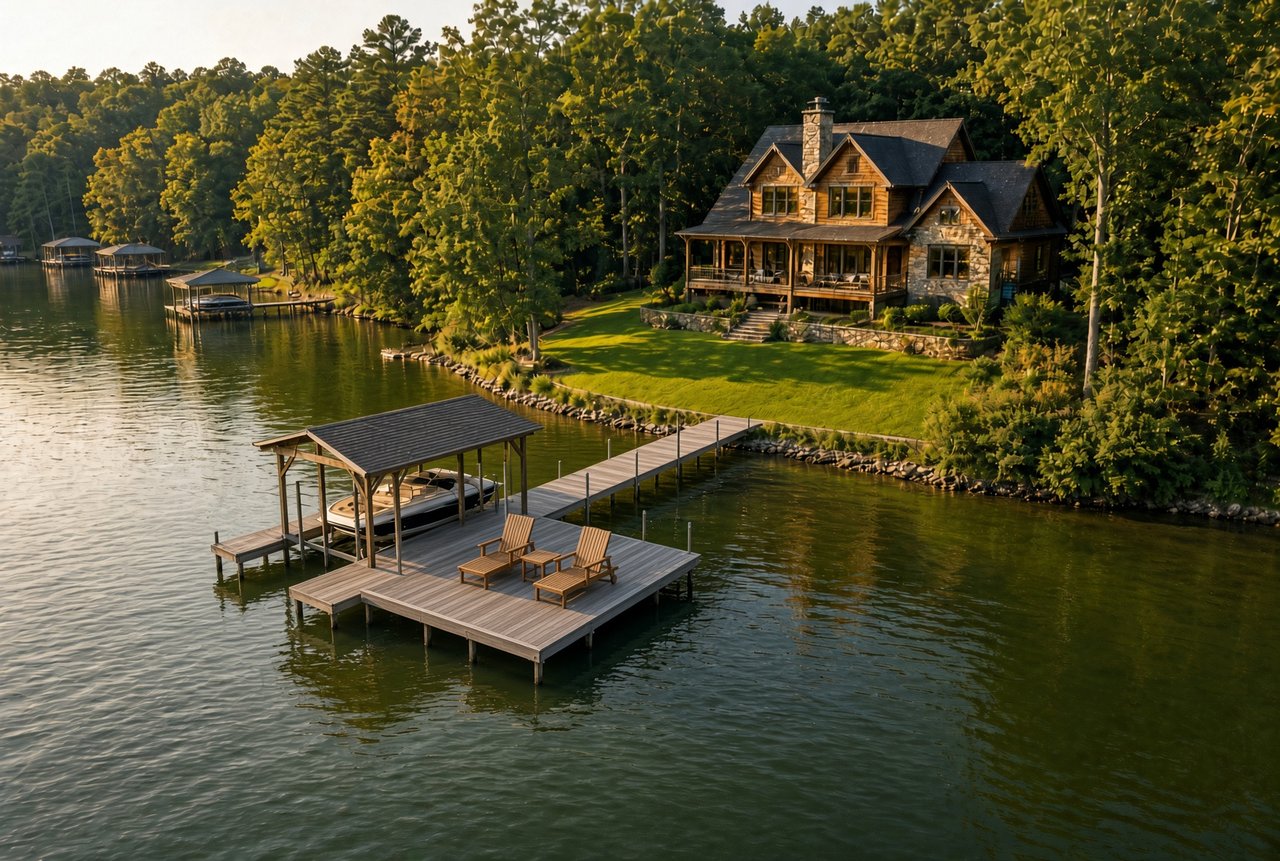
- Aerial and satellite imagery. Current imagery shows shoreline shape, dock configuration, how much frontage is usable versus riprap or steep bank, tree cover over the water, and lot orientation. Sunset exposure is a real premium at this lake and it is measurable from a map.
- Dock and shoreline permitting history. Dock structures at Lake Anna are permitted. What is on file matters: the permitted size, whether a lift or boathouse is included, and what your shoreline classification allows a buyer to change later.
- Water depth at the dock. The single most underweighted variable in Lake Anna pricing. Depth at the end of the dock at normal pool, and more importantly at winter drawdown, separates a house a boater pays a premium for from one they pass on.
- Cove and channel position. Distance to the main channel, no wake status, how protected the cove is, and how much traffic passes your dock all move the number without touching the house.
- Prior listing history and photos. If the property has ever been listed or marketed as a short term rental, there is a photographic record of the interior. Combined with your own note on what has changed, that fills in most of the inside.
- County records. Tax assessment history, recorded improvements, permits pulled, and well and septic records, from Louisa, Spotsylvania, or Orange depending on where you sit.
- Comparable sales, filtered properly. This is where local judgment does the heavy lifting. Your comp set is not "waterfront homes at Lake Anna." It is the handful of sales that share your side of the lake, your depth profile, your dock capability, and your cove character, adjusted for the ones that do not match.
What you would need to provide
The gap between a rough number and a tight one is about ten minutes of your time:
- Anything updated in the last five to seven years, especially roof, HVAC, septic, well, kitchen, and dock
- Whether the property would convey furnished, and roughly what stays
- Any short term rental income history, which matters significantly in the right community
- Condition items you already know about, since a number built on a rosy assumption is not useful to you
- Anything unusual about the lot, easements, or shared access
You can send that in an email. Nobody needs to open your closets.
What you should expect back from us
A useful desk valuation gives you a range, not a single figure, along with the reasoning: which sales were used, why, and what moves you toward the top or the bottom of that range.
It should tell you what a buyer at this lake pays a premium for on your specific property, and what would need attention before it goes to market. It should come with an honest read on timing, because at Lake Anna the calendar affects the number. Median days on market here has been running in the 80 to 90 plus day range, meaningfully slower than the suburban markets most sellers compare against, and that pace changes how you should think about when to list.
If the report says the property is worth more than you assumed, you have a decision to make on your own schedule. If it says the number is not there yet, you have saved a listing appointment and gotten a punch list. Either outcome is worth having.
Two questions worth asking any agent
Whoever you eventually interview, including us, ask both of these and ask for the answers in writing.
1. What are you spending to market my home, specifically? Not what platforms it goes on. What gets shot, what gets built, and what it costs. On waterfront, a listing that never gets photographed from the water is a listing marketed as if it were in a subdivision.
2. What happens if it has not sold in the first 21 days? A price is a hypothesis. The plan for what you do when the market disagrees with it matters more than the number on day one, and it should exist before you list, not after.
An agent who has good answers to those two has thought about your property. An agent who has not will tell you a number and hope you like it.
Who you are reading
The M Group works Lake Anna specifically. Louisa, Spotsylvania, and Orange. The private side and the public side. Dock permits, shoreline classifications, cove position, and what the water actually does at winter drawdown.
We built this business on this water in five years, and we have grown it every year since. When you ask us what your property is worth, you are not getting a countywide average with a waterfront adjustment stapled to it. You are getting an answer from people who work your cove.
We will also tell you when the answer is to do nothing. That is a real answer, and we would rather give it to you in February than in August.
Frequently asked questions
Can I find out what my Lake Anna home is worth without listing it?
Yes. A written desk valuation is not a listing agreement and does not obligate you to sell, meet, or sign anything. Send an address, get a range and the reasoning behind it.
How accurate is a valuation without a walkthrough?
On Lake Anna waterfront, most of the value drivers are outside the house: water depth, dock permitting, cove position, and side of the lake. A desk valuation built from those, plus your own notes on interior condition and updates, produces a defensible range. A walkthrough narrows the range. It rarely moves it much.
Why is my Zillow or Redfin estimate so far off on my lake house?
Automated models rely on volume and similarity. Lake Anna has roughly 200 miles of shoreline, about 13,000 acres of water, three counties, and no two coves that price the same. The models cannot see depth, dock permits, or the private side versus public side distinction, which alone is often a six figure difference.
Does the private side really change the price that much?
Routinely, yes. The private side is the warm side, the Dominion Energy cooling lagoon serving North Anna, restricted to property owners and their guests with no public ramps. Two comparable homes on opposite sides of that line frequently sell six figures apart.
Do I need a survey, an appraisal, or an inspection first?
No. Those come later and only if you decide to sell. Start with public records and a conversation.
What does it cost?
Nothing, and there is no obligation attached to it.
The point
You are allowed to be curious about your own asset without starting a process. Wanting a number is not the same as wanting a sign in the yard, and any agent who cannot tell the difference is telling you something about how they would handle the rest of the transaction.
Want the number without the walkthrough?
Send The M Group your address and we will put together a written valuation on your Lake Anna property using dock and shoreline records, depth data for your cove, county records, and the sales that actually compare to yours.
No appointment, no pressure, no sign in the yard. If you decide to do nothing with it, that is a perfectly good outcome. Call, text, or email either of us and we will get started this week.
Two questions worth asking any agent you interview at Lake Anna, including us: what are you spending to market my home, and what happens if it has not sold in the first 21 days? Get both answers in writing.
