Lake Anna waterfront rules · Part 5 of 8
The tree between your deck and the water may not be your tree. Here is how to find out, what you can do with it either way, and why "I'll just cut it" is the most expensive sentence at the lake.
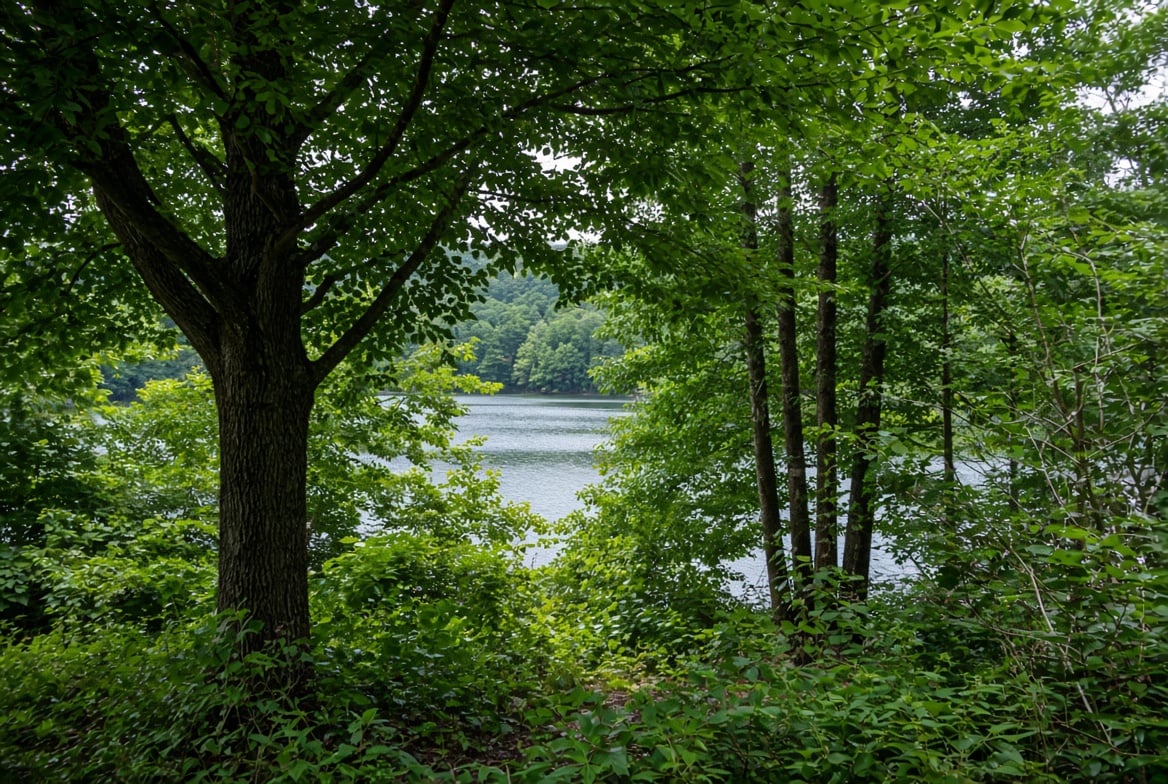
Every waterfront owner at Lake Anna has one. A sweetgum, a Virginia pine, a tulip poplar that has been growing since the lake filled in 1972, standing exactly where the sunset should be. The question comes up at closings, at cookouts, and in our inbox every spring: can I take it down?
The answer depends on something most people have never checked: which side of a line the trunk is on. In Part 1 we explained that the land below the 250-foot contour is Dominion's, and what you hold across it is a set of recorded rights. Those rights cover a dock, a ramp, a path, bank stabilization. They do not include timber. A tree rooted on Dominion's shore land is Dominion's tree, in the plain property-law sense, and cutting it without asking is cutting down someone else's tree.
That sounds alarming. It is not meant to. People trim, thin, and occasionally remove shoreline trees at Lake Anna all the time, legally, with a phone call and in some cases a short form. The point of this article is to show you where the lines are so the phone call is a formality and not a problem.
Start with the short answer
Above the easement line, on your own land: In Louisa and Orange, trees on your property are yours, subject to your HOA covenants and the county's erosion rules if you clear enough ground to count as land disturbance. In Spotsylvania, the first 100 feet back from the water is a state-mandated buffer and the county has to approve most tree removal there, though pruning for a view is specifically allowed.
Below the easement line, on Dominion's shore land: Ask before you cut. Dominion's Lake Anna guidelines do not contain a tree section, which surprises people, but the land is theirs and the Reservoir Coordinator is the one who says yes. Limbing and pruning for a view are routinely approved. Removal is case by case.
Dead, dying, diseased, or dangerous: Removable everywhere, with a call first on Dominion's land and county approval in Spotsylvania's buffer. Nobody wants a dead pine falling on your dock.
Clear-cutting for a lawn to the water: No, in all three counties, for different reasons, and it is the one move that gets owners fined and ordered to replant.
First, find the line
Everything in this article turns on whether a tree is above or below the Dominion easement line, which runs at the 250-foot contour, or wherever your deed and plat show the easement boundary on your specific lot. Some parcels run to the 250 line. Some have a flowage easement that reaches higher. Your plat is the source, and the Louisa shoreline packet requires it to be drawn in: "Area of Dominion Power easement, clearly identified."
Practically: full pond is 250 feet. On a day the lake is full, the water's edge is the line, give or take the slope. This fall the lake has been sitting near 248, so the line is a couple of vertical feet up the bank from where the water is now, which on a gentle shore can be fifteen or twenty feet of horizontal distance. If you are not sure, a surveyor can flag the contour in an hour. If a tree is close enough that you are guessing, assume it is Dominion's and make the call. The call is free.
Trees on Dominion's shore land
Here is the honest state of the written rules: Dominion's General Guidelines and Construction and Use Agreement for Lake Anna address docks, ramps, bulkheads, rip-rap, dredging, and excavation. They say "Vegetative plantings also are suggested to enhance the aquatic life forms existing on the lake bed." They do not contain a sentence about cutting trees. Dominion's guidelines for its other Virginia reservoirs are more explicit, but Lake Anna's are not, and we are not going to pretend otherwise.
What fills the gap is ownership. The shore land is Dominion's property. Virginia's timber trespass statute, Code of Virginia section 55.1-2836, is blunt about what happens when someone cuts timber on land they do not own without permission: three times the value of the timber on the stump, reforestation costs, the cost of valuing the trees, and the owner's attorney fees. That statute was written for logging disputes, not lake houses, and we have never heard of Dominion using it against a homeowner over a single tree. But it is the reason the Reservoir Coordinator's office, and not your chainsaw, is the first stop. The guidelines also remind owners that the Construction and Use Agreement is "revocable," and that unapproved work "could result in corrective actions deemed appropriate by Dominion Energy." On trees, corrective action usually means replanting.
A word on what follows. Because Dominion has not published a tree policy for Lake Anna, the next section describes how requests are generally handled, based on the best information we could find and on what owners around the lake report. It is not a Dominion rule and it is not a guarantee of how your request will be answered. Treat it as a map of the usual outcomes, confirm your situation with the Reservoir Coordinator before any work, and if your experience differs from what you read here, let us know and we will update the article.
What generally gets approved, based on what we see around the lake:
- Limbing up and pruning for a view. Taking lower branches, thinning a canopy, opening a window to the water. This is the most common request and the most commonly approved. The tree stays, the roots keep holding the bank, and you get your sunset.
- Removing dead, dying, or hazardous trees. Approved readily, often with a request that the stump and roots stay in place for bank stability. Bring a photo.
- Removing a healthy tree. Case by case. The question Dominion is asking is whether the bank erodes without it. On a rip-rapped or bulkheaded shoreline the answer is often no and the removal goes through. On a natural bank with a 15 percent slope the answer may be a request to prune instead.
- Clearing a strip to the water for grass. Not approved, and not something you should want. Turf to the waterline is the single biggest source of shoreline erosion on the lake. It also removes the shade that keeps the cove water cooler, which matters more every August.
How to ask: call the Reservoir Coordinator at (540) 894-2307 with your address, a description of the tree and what you want to do, and a photo. Many requests are handled with a site visit and a verbal approval. If the work is part of a larger project, a dock rebuild or a bank stabilization job, it goes on the same Construction and Use Agreement application as the rest of the work.
One habit worth building: get the approval in writing, even if it is an email that says "approved as discussed." The agreement is non-transferable to a new owner, and in Part 3 we explained why a buyer wants to see the paper trail. A tree removed with an email on file is a non-event at your sale. A stump with no paper is a question.
Trees on your own land: county by county
Above the easement line, the tree is yours. What you can do with it depends on the county, and this is where Lake Anna's three-county reality matters most, because the rules are not close to the same.
Spotsylvania County: the 100-foot buffer
Spotsylvania is a Chesapeake Bay Preservation Act locality. Louisa and Orange are not; the state statute lists the Tidewater counties by name, and only Spotsylvania among the three made the list. That single fact explains most of the differences in this section.
Under the Bay Act, the first 100 feet landward from the water is a Resource Protection Area buffer, and the county's Division of Environmental Codes regulates what happens to the vegetation in it. The state regulation, 9VAC25-830-140, spells out the exceptions a homeowner gets, and Spotsylvania applies them with county approval:
- Sight lines and vistas. The regulation's words: "Trees may be pruned or removed as necessary to provide for sight lines and vistas." Removed trees must be replaced with vegetation "equally effective" at controlling runoff and erosion, mature trees are supposed to be pruned rather than removed where possible, and removal is limited to the fewest trees that get you the view.
- Dead, diseased, or dying trees and noxious weeds (the regulation names Johnson grass, kudzu, and multiflora rose) may be removed, again with approval and replacement.
- Access paths to the water are allowed if built so they "effectively control erosion."
- Shoreline erosion control projects may remove trees as needed, with replanting as part of the project.
What the county will not approve: clear-cutting, removing native vegetation to make lawn, or expanding an existing lawn deeper into the buffer. Existing lawns and landscaping as they stood when the RPA was mapped can be maintained. New ones cannot be created. Anything bigger than the exceptions above goes through the county's Exception Request Application and, for structures in the buffer, a public hearing. The office is Spotsylvania Environmental Codes, (540) 507-7219. We covered the RPA framework more broadly in this earlier piece.
The practical read: in Spotsylvania, you can get your view. You get it by pruning first, removing second, replanting always, and asking before any of it.
Louisa County: erosion rules, not tree rules
Louisa has the lake's only shoreline ordinance, Sec. 86-455.1, and people assume it regulates trees. It does not, directly. Its stated purpose is erosion: "This section is intended to mitigate the impacts to the shoreland of residential and commercial development." It contains no tree-cutting provision and no view-corridor provision.
What it does regulate is land disturbance. "Land disturbances over 10,000 square feet (SF) along the Lake Anna waterfront shall require a Lake Anna shoreline agreement," and any disturbed shoreland "shall be permanently stabilized." Taking down one tree is not 10,000 square feet. Clearing a quarter acre of waterfront with a skid steer is, and that triggers the shoreline packet, a Responsible Land Disturber on the job, and stabilization within seven days of final grading under the county's agreement in lieu of a plan. The penalty clause is real: a fine of up to "$1,000.00 per violation (each day of violation)."
Louisa's ordinance also tells you what the county would prefer, without requiring it on existing lots: shoreland protection "may include a 100-foot wide natural, forested buffer along the shoreline," defined as "an indigenous, undisturbed, riparian forest" with "ground cover, shrub, and tree canopy layers." On slopes over 15 percent it calls for a 25-foot undisturbed vegetated strip at the water. And one rule applies everywhere along the Louisa shoreline whether you disturb anything or not: "Applications of fertilizers and herbicides are prohibited within the berm, swale, and buffer areas and within 25 feet of the shoreline."
So in Louisa, the tree in your yard above the easement line is yours to prune or remove, subject to your covenants. Clearing is where the county shows up. Louisa Community Development: (540) 967-3430.
Orange County: covenants and common sense
Orange has no shoreline ordinance, is not a Bay Act locality, and has no lake-specific tree rule. Above the easement line, your trees are yours. What governs is your subdivision's covenants, which at Lake Anna often say more about tree removal than any county does, and the statewide erosion and sediment control rules that kick in for larger clearing. Below the easement line, it is Dominion's land in Orange exactly as it is everywhere else. Orange County Planning and Zoning: (540) 672-4347.
Your HOA may be the strictest rulebook of all
We would be doing you a disservice if we left this out. Many Lake Anna communities, particularly the newer ones on both sides, have architectural review covenants that require approval to remove any tree over a certain diameter, anywhere on the lot. Some require replacement. Some prohibit removal within a set distance of the water regardless of what the county says. These are private contracts you agreed to when you bought, and they are enforceable by the association.
We have not cataloged every community's covenants, and they change by amendment. Before you call Dominion or the county, read your own. If you are buying, ask for them during due diligence and read the tree section. It is usually short, and it is usually the one that bites.
The tree that falls on its own
A tree on Dominion's shore land comes down in a storm and lands in the water, on your dock, or across your neighbor's seawall. Who cleans it up?
In practice, you do, and Dominion is glad to let you. Storm debris removal is not the kind of "cutting" anyone objects to, and a call to the Reservoir Coordinator to say "a tree came down, we are clearing it" is a courtesy that takes two minutes. The one place to slow down is the stump and root ball on a natural bank: leaving it in place often holds the bank better than pulling it, and Dominion may ask you to leave it. If the tree took out part of your dock, the repair is a repair under your existing agreement, which we covered in Part 2.
Who pays for the dock is a homeowner's insurance question, not a Dominion one. Check whether your policy covers the dock as an "other structure" and at what limit. Many default policies cap it low.
What to plant instead
Every county that regulates this, and Dominion itself, points the same direction: native, woody, and rooted. Louisa's ordinance wants "native grasses or shrubs." The Bay Act regulation wants replacement vegetation "equally effective in retarding runoff, preventing erosion, and filtering nonpoint source pollution." Dominion's guidelines suggest "vegetative plantings" along the bank.
For a Lake Anna bank, that means river birch, red maple, serviceberry, and buttonbush at the water; switchgrass, little bluestem, and black-eyed Susan on the slope; and keeping the leaf litter where it falls. It also means skipping the fertilizer within 25 feet of the water in Louisa, and everywhere else as a matter of not feeding the algae that closes swimming areas in August. A shoreline planted this way needs less work every year, not more, and it is the cheapest erosion control there is.
Buying? Three tree questions for due diligence
- Where is the easement line on this lot, and which trees are below it? Get the plat, walk it, and understand that the big ones at the water are probably Dominion's.
- Has anything been cleared in the last few years, and is there paper for it? Fresh stumps along the water with no Dominion email and no county record are a flag, especially in Spotsylvania, where the county can require replanting from the current owner, meaning you.
- What do the covenants say about tree removal? Read the section before you fall in love with the idea of a bigger view.
Where to start
If you want to open up a view: start with pruning. Hire an arborist who works at the lake, have them stand on your deck and tell you what limbing would accomplish, and call Dominion for anything below the line. Most owners get 80 percent of the view they wanted without removing a tree.
If you have a hazard tree: photograph it, call the Reservoir Coordinator if it is on the shore land or Environmental Codes if you are in Spotsylvania's buffer, and get the approval in writing before the crew shows up.
If you are planning any clearing: pull the plat, measure the area, and if it is anywhere near 10,000 square feet in Louisa or inside the 100-foot buffer in Spotsylvania, call the county before the equipment does.
Buying or selling waterfront at Lake Anna? Trees, docks, and the paper behind them are part of every waterfront deal we handle. Talk to us about buying or get a straight answer on what your waterfront is worth. And if you have not yet, subscribe to the Lake Life Briefing, our weekly newsletter with lake levels, weather, events, new listings, and the next part of this series before it hits the site.
The Lake Anna Waterfront Rules series
Part 1: The Dominion Easement at Lake Anna: What It Really Is
Part 2: How Big a Dock Can You Build at Lake Anna?
Part 3: Does a Lake Anna Dock Convey With the House?
Part 4: Can You Run Power and Water to a Lake Anna Dock?
Part 5: Trees, Views, and Clearing (this article)
Next in this series: beaches and bank stabilization. What it takes to put in a sand beach at Lake Anna, when rip-rap beats a bulkhead, and why the county cares more about your bank than your dock.
Please verify before you act on it. Guidelines get revised, ordinances get amended, and no article keeps pace with all of it. This article is based on the best information we could find as of its publication date, including the ordinance and regulation text we quote, and on the experience of owners we work with where no written rule exists. Some points, particularly how Dominion responds to individual tree requests and what it asks for on steep or natural banks, are our understanding of common practice rather than published policy. It is intended to give you a starting point and a working understanding, not a final answer for your property or your project, and we ask that you double-check anything that applies to you before you act on it. Confirm anything that applies to you directly with Dominion Energy's Reservoir Coordinator at (540) 894-2307, and with your county: Louisa County Community Development at (540) 967-3430, Spotsylvania County Division of Environmental Codes at (540) 507-7219, or Orange County Planning and Zoning at (540) 672-4347. Your subdivision's covenants may impose stricter limits than any of them.
What we are and are not. The M Group is a real estate brokerage. We are not attorneys, arborists, engineers, or a permitting authority, and this article has not been reviewed or endorsed by Dominion Energy or any county. The description of how Dominion handles tree requests reflects our experience and that of owners we work with, not a published Dominion policy. Nothing here is a legal opinion on any specific property. We make no warranty as to accuracy or completeness and accept no liability for decisions made in reliance on this article. If you spot something that has changed or that we got wrong, email [email protected] and we will verify it and update the article.
