Lake Anna waterfront rules · Part 4 of 8
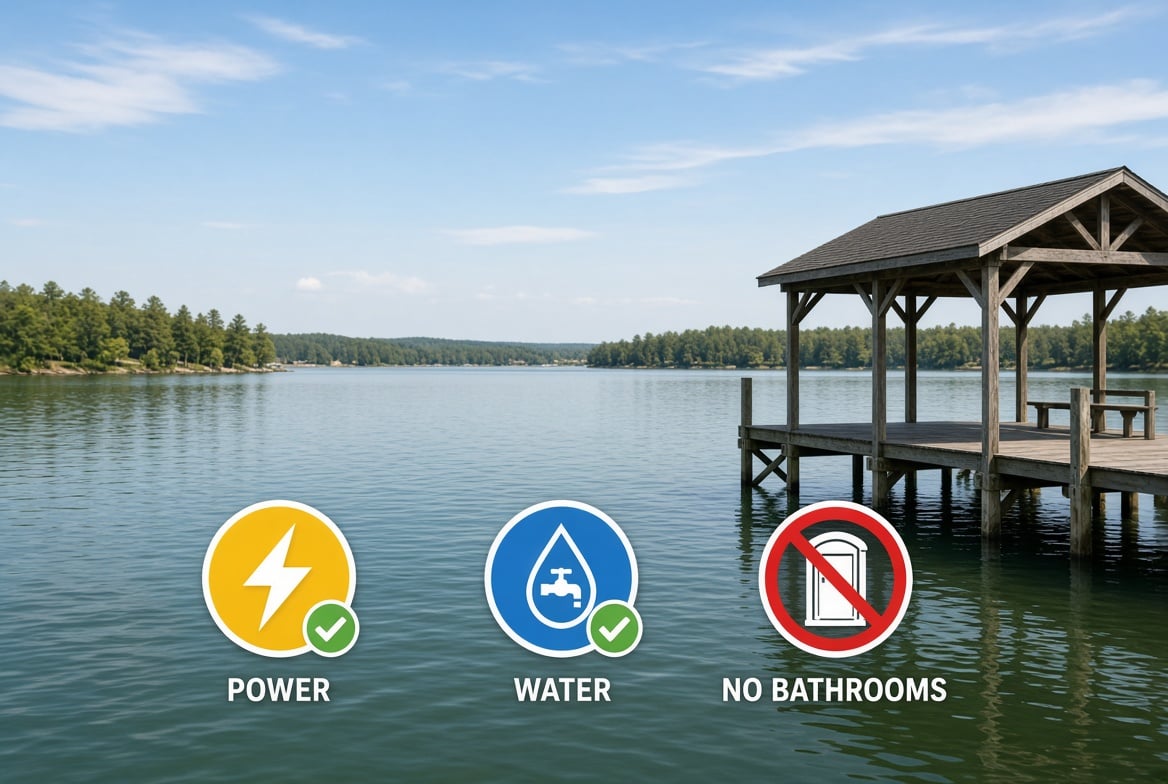
Power, yes, with a permit and an inspection. Water, yes, for the hose and the sprinklers. A bathroom, no, not anywhere on Dominion's land.
This is the question we get most often once a buyer understands what the easement actually is. If Dominion holds the shore land and you hold recorded rights across it, can you run a power line down to the dock for the boat lift and the lights? Can you drop a pump in the lake for the sprinklers? And the one people ask quietly, because they suspect the answer: can you put a bathroom on the dock so nobody has to walk up the hill?
The short version is above. The longer version is worth ten minutes, because the rules come from three different places, and the part that matters most is not a Dominion rule at all. It is a safety rule, and it is the reason this article exists.
Start with the short answer
Electricity: Nothing in Dominion's guidelines prohibits power on a dock, and nearly every boat lift on the lake runs on it. What governs the wiring is the Virginia building code, which means a county electrical permit, a licensed electrician or a signed owner exemption, and a passed inspection. Do it right and it is routine. Do it wrong and it can kill a swimmer.
Water: A hose bib on the dock fed from the house is fine. Pumping lake water for irrigation is common, legal at residential volumes, and unregulated by the state below a threshold no lawn will ever reach. The line itself crosses Dominion's land, so the trenching, not the water, is what needs a conversation.
Bathrooms: No. Dominion's guidelines name sinks, toilets, and showers specifically, and Louisa's ordinance repeats it. The bathroom goes in the house or in a landside structure on your own land.
Now the reasons, because the reasons are what let you plan around the rules instead of bumping into them.
Three rulebooks, not one
Everything below the 250-foot contour at Lake Anna is Dominion's land, and everything you build on it happens under the General Guidelines and Construction and Use Agreement. We walked through that document in Part 1 and used it to size a dock in Part 2. Here is the thing about it that surprises people on the utilities question: it says almost nothing about utilities.
The guidelines tell you what a dock may be. They do not tell you how it must be wired. That job belongs to the Virginia Uniform Statewide Building Code, which applies identically in Louisa, Spotsylvania, and Orange. And the permit that proves you followed the code comes from whichever county your parcel sits in.
So, three rulebooks:
- Dominion's guidelines decide what is allowed on the shore land at all: a dock, a lift, a light, a hose bib, yes; a toilet, a sink, a window air conditioner, an enclosed room, no.
- The Virginia building code decides how anything electrical or plumbed must be built. The 2021 edition took effect January 18, 2024, and it adopts the 2020 National Electrical Code. Article 555 of that code is written for marinas, boatyards, and "docking facilities," and it includes docks at one-family homes.
- Your county issues the permit, sends the inspector, and in Louisa's case adds a shoreline ordinance on top. Spotsylvania adds Chesapeake Bay Preservation Act review. Orange adds neither, but the state code still applies there in full.
Water is the same pattern with one more player, the Virginia Department of Environmental Quality, and we will get to it.
Power on the dock: what Dominion allows
Dominion's guidelines do not contain the word "electrical." What they contain are two prohibitions that shape the whole question.
The first: "Structures shall not be used for human habitation whether located over water or on Dominion Energy's shore land." The second, from the same section: "Household furnishings, such as sinks, toilets, showers, window heating/cooling units, etc are not permitted on these structures."
Read those together and the intent is clear. Power that serves a dock as a dock is fine: a boat lift, a personal watercraft lift, dock lights, a receptacle for a battery charger or a radio, a ceiling fan under the roof. Power that turns the dock into a room is not. A window air conditioner is named. A mini-split bolted to a screened second story is not named, but it fails the same test, and if you have to ask whether something makes the dock habitable, the answer is to ask the Reservoir Coordinator before you buy it, not after.
Boat lifts deserve one more sentence because they are the reason most docks have power in the first place. As we noted in Part 2, lifts appear nowhere in Dominion's written guidelines. In practice they are on nearly every private dock on the lake, and Dominion reviews them as part of the structure. Nobody is going to make you crank a lift by hand. But the lift motor is, statistically, the single most likely thing on your dock to put current in the water, and that brings us to the part that matters.
Power on the dock: what the code requires, and why
On July 4, 2024, an 18-year-old swimming near a private dock at Smith Mountain Lake stopped responding in the water and died. The people who pulled him out reported feeling shocks. First responders measured voltage in the water that disappeared when the dock's electric boat lift was raised. The Electric Shock Drowning Prevention Association had documented 112 cases nationally between 1986 and 2023, and before that day Virginia had recorded one, in 2001.
Electric shock drowning is a fresh water problem. Salt water conducts better than the human body, so current goes around a swimmer. Fresh water conducts worse, so current goes through. It does not take much. Enough to paralyze the muscles is enough to drown someone who was a strong swimmer thirty seconds earlier, and the people who jump in to help get the same current.
Lake Anna is fresh water. Almost every dock has a lift. That is why the building code treats a residential dock the way it treats a marina, and why the inspection is not paperwork.
Your electrician will know Article 555 and will know which provisions apply to a single-family dock as opposed to a commercial marina. You do not need to learn the code. You do need to know enough to ask five questions and recognize a good answer:
- Ground fault protection on everything. The 2020 code requires ground fault protection on dock receptacles set to trip at no more than 30 milliamps, and on the feeder serving the dock at no more than 100 milliamps. Ask which devices provide it and where they are. A boat lift running on 240 volts or less needs ground fault protection too.
- A disconnect you can reach from land. The code requires a means to shut the dock off. Practically, you want one switch or breaker at the shore end that kills everything on the dock, labeled, and you want every adult in the house to know where it is. Throw it before anyone swims. Every time.
- Receptacles above the datum plane. The code sets an "electrical datum plane" above the water and requires receptacles at least 12 inches above the deck and above that plane. On a floating dock the plane moves with the water. The lake fluctuates, as Dominion's own guidelines warn, and this September it has been sitting near 248 feet. Your electrician needs to size the installation for full pond, not for the day of the inspection.
- Wet-location wiring, no extension cords. The code specifies wiring methods rated for wet locations and allows flexible cable only in limited places. The orange extension cord running from the garage to the lift is not one of them. It is also the most common thing we see on docks, and it is exactly how stray current gets into the water.
- Bonding. Metal parts on the dock, including the lift frame, should be bonded together and to the grounding system so a fault trips a breaker instead of energizing the lake. Ask the electrician to show you the bonding jumper.
Then the maintenance side, which no inspector will do for you:
- Press the test button on every ground fault device monthly. They fail, and they fail silently.
- Have the dock's electrical inspected annually, before the season, by an electrician who does marine work. Lift motors, cables, and connections live in a wet, moving environment.
- Never swim within 50 feet of a dock with power on, yours or a neighbor's. Kill your dock's disconnect before anyone gets in the water.
- If someone in the water suddenly feels tingling or can't move, do not jump in. Shut off the power, throw a float, and call 911. Rescuers are the second victims in these cases.
- Consider a shore power monitor or a dock leakage alarm. They are inexpensive and they exist because of exactly this problem.
None of that is meant to scare anyone away from a powered dock. It is meant to make the case that the permit, the inspection, and the licensed electrician are not bureaucracy. They are the whole point.
Lights and reflectors
Dock lighting is allowed and Dominion's guidelines do not regulate it. Louisa County's shoreline ordinance recommends, without requiring, that lights have an initial output under 2,000 lumens or be fitted with opaque shields so the source is not directly visible from the water. That is a dark-sky standard, and it is worth following on every part of the lake whether your county asks for it or not. The people across the cove will notice.
Louisa also requires reflectors on lake structures: two-inch minimum diameter, along the sides at ten-foot intervals, placed no more than two feet above normal pool. Spotsylvania and Orange do not have an equivalent ordinance, but the reason for the rule, a boat coming home after dark, does not stop at the county line.
The permit, county by county
This is where the three counties diverge, and where a lot of "the rules" people repeat at the boat ramp turn out to be Louisa's rules applied to a Spotsylvania or Orange parcel. Lake Anna touches all three. Only Louisa has a shoreline ordinance. The building code is the same everywhere.
Louisa County
Louisa treats a dock as a "Lake Structure" with its own permit type. The application requires a plat or scaled plan, one full set of building plans with the designer's name on them, the contractor's state license or a signed exemption, a Responsible Land Disturber certificate, and a separate Louisa County Shoreline Packet for Lake Structures. The county's own instructions say it plainly: "If any portion of the project affects property owned by Dominion Power, approval will be needed." Dominion's sign-off comes first, then the county.
The electrical is permitted as a trade under that application, or separately as a trades permit if you are adding power to an existing dock. Louisa's list of residential permit types even includes a temporary electrical permit for service "to any dwelling or accessory building, such as a garage or boathouse," which tells you how normal a wired boathouse is here. Louisa Community Development: (540) 967-3430, or [email protected].
Spotsylvania County
Spotsylvania has no dock ordinance. It has the Chesapeake Bay Preservation Act, which puts the shoreline in a Resource Protection Area, and its Division of Environmental Codes treats docks and seawalls as water-dependent structures that are allowed in the RPA with a site plan and a Water Quality Impact Assessment. Boathouses, in the county's words, "typically do not impact the RPA" and can be approved through an Environmental Codes Accessory Agreement in Lieu rather than a public hearing. We covered the RPA framework in this earlier piece if you want the full picture.
For the wiring, Spotsylvania issues an Electrical-Only permit. Either a licensed contractor or the owner may apply. If you do the work yourself you sign a Landownership Exemption for Licensure Statement; otherwise the application needs a Virginia contractor's license and a master tradesman certification. Fees as of this writing are $45 plus $100 per trade plus a 2% state surcharge, and inspection results post online. Community Development: (540) 507-7222. Environmental Codes for the RPA questions: (540) 507-7260.
Orange County
Orange has neither a shoreline ordinance nor a Lake Anna-specific process, and its zoning code has no dock provisions. What it has is the same statewide building code as everyone else, which means the same electrical permit and inspection requirement, and the same Dominion approval for the structure itself. Start with Orange County Planning and Zoning at (540) 672-4347 and ask to be routed to Building Inspections for the trade permit. If anyone tells you Orange does not require an electrical permit for a dock, they are wrong. The state requires it. The county is simply the one who issues it.
The sequence, in every county: Dominion's Reservoir Coordinator approves the structure and anything on it. Then the county issues the building and electrical permits. Then a licensed electrician (or you, under an owner exemption where your county allows it) does the work. Then the county inspects. Then you turn it on. Reverse any two of those steps and you are the one holding the problem when you sell.
Water to the dock
Two different things get called "water on the dock," and they have different answers.
A hose bib fed from the house. This is a plumbing line run from your domestic water supply down to a spigot at the dock. Dominion's guidelines do not address it and we have never seen it questioned. It is a fixture that serves the dock as a dock: rinsing the boat, filling a cooler, washing off feet. Where it needs attention is the trench, because you are crossing Dominion's land to get there, and in Louisa any land disturbance in the shoreline district runs through the shoreline packet. Freeze protection is your problem, not the county's. Drain it in November.
A pump pulling lake water for irrigation. Very common at Lake Anna, and legal at residential volumes. Virginia DEQ requires reporting of surface water withdrawals only when they average more than 10,000 gallons per day, or 300,000 gallons in a month. A residential sprinkler system does not approach that. Dominion's guidelines are silent on intake lines, but the intake sits in the lake and the pipe crosses the shore land, so this is a call to the Reservoir Coordinator before you dig, not a surprise for them after. Two practical points:
- Set the intake deep enough that a drawdown does not leave it sucking air. The lake has spent this summer within a foot of 248, two feet under full pond. An intake set for 250 was a bad summer for a lot of lawns.
- The pump is electrical equipment on or near the dock, so everything in the power section applies to it, including ground fault protection and the shore-side disconnect.
What water on the dock is not: a sink. A sink is a household furnishing, and Dominion names it. A spigot and a bucket are a dock. A sink with a drain is a kitchen.
Bathrooms, showers, and sinks
This is the shortest section because the rule is the clearest one in the guidelines. "Household furnishings, such as sinks, toilets, showers, window heating/cooling units, etc are not permitted on these structures." Louisa's ordinance adds its own line: "Restrooms are not allowed within the Dominion easement without their approval," and the only context where the ordinance contemplates approval is a community common area serving 25 or more lots, where a restroom is actually required. That is the exception that tells you how narrow the rule is. A subdivision boat ramp with a hundred families may get one. Your dock will not.
The reason is not prudishness. A toilet needs a drain field or a holding tank, and the shore land is Dominion's, sits inside a state water quality buffer in Spotsylvania, and is the last place any county health department is going to approve a septic component. A shower is a sink on a wall. And any of the three moves the structure toward "human habitation," which is the line Dominion cares about most.
The answer everybody lands on is the right one. Put the bathroom in a landside structure on your own land, above the easement line, with a proper septic connection. If you want to know what "proper" means at the lake, we wrote the septic explainer. A pool house or a detached garage with a half bath, sited outside the easement and outside the RPA buffer where that applies, gives you the same short walk without the fight.
And no, a portable toilet on the dock does not solve it. It is a toilet.
The gray zone: fridges, TVs, fans, and outdoor kitchens
Dominion's list ends with "etc," which means the named items are examples of a category, not the whole category. The category is things that make a structure a place to live. So:
- Ceiling fans under a roofed dock: a dock fixture. Fine.
- A dock box with a charger inside: fine.
- A small refrigerator: not named, and common on the lake, but it is a household appliance on Dominion's land. We would ask before installing one, and we would never build a cabinet around it.
- A TV under the roof: same answer.
- A grill or outdoor kitchen on the dock: a built-in kitchen with a sink is prohibited by the sink alone. A freestanding grill is a grill. The moment it has plumbing or a countertop with a basin, it is furnishing.
- A screened second story: allowed. "Waterfront construction may have a second story but it may not be enclosed. Screened areas are not considered to be enclosed." Screen it. Do not glass it. Do not heat or cool it.
The test that works: if a photo of it would make a stranger say "you could live out there," Dominion will say the same thing.
Buying a house with a wired dock? Five questions
Most docks you will look at already have power. Some were wired well, permitted, and inspected. Some were wired by the previous owner's brother-in-law in 2009. In Part 3 we said the dock conveys with the house and there is no Dominion step at closing. That is still true. It is also true that nobody at closing is going to check whether the dock is safe. That is your due diligence period, and these are the questions:
- Is there an electrical permit and a final inspection on file with the county for the dock? Louisa, Spotsylvania, and Orange all keep permit records. Ask the listing agent, then verify with the county yourself.
- Where is the shore-side disconnect, and does it kill everything? If the seller has to think about it, note that.
- Do the ground fault devices trip when tested? Press the buttons during the inspection. Every one.
- How old is the lift motor and wiring, and who serviced it last? Ask for the invoice.
- Have your home inspector, or a marine electrician, put a meter in the water around the dock with the lift running. This takes five minutes, costs little, and is the single most valuable test you can run on a Lake Anna waterfront house. A reading above zero is a repair item before you close, not after.
If the answers are bad, none of that is a reason to walk away from the right house. It is a reason to price the electrician into the offer. Rewiring a dock to code is a few thousand dollars. It is the cheapest safety upgrade on the property.
Where to start
If you own now and want to add power or water: call Dominion's Reservoir Coordinator at (540) 894-2307 with a sketch, then call your county, then call an electrician who does marine work and ask them to walk the dock before quoting. In that order.
If you own a dock with power already and have never had it inspected: schedule that this fall, while the lake is quiet and the lift is out of the water anyway.
If you are buying: put the five questions above in your inspection contingency and let us handle the county records.
Buying or selling waterfront at Lake Anna? The dock's paperwork is part of the deal, and we read it before you sign. Talk to us about buying or get a straight answer on what your waterfront is worth. And if you have not yet, subscribe to the Lake Life Briefing, our weekly newsletter with lake levels, weather, events, new listings, and the next part of this series before it hits the site.
The Lake Anna Waterfront Rules series
Part 1: The Dominion Easement at Lake Anna: What It Really Is
Part 2: How Big a Dock Can You Build at Lake Anna?
Part 3: Does a Lake Anna Dock Convey With the House?
Part 4: Power, Water, and Bathrooms on the Dock (this article)
Next in this series: the trees. What you can trim, what you can cut, and what happens when a tree between your house and the water is on Dominion's land and not yours.
Please verify before you act on it. Guidelines get revised, ordinances get amended, code editions change, and no article keeps pace with all of it. This one is intended to give you a starting point and a working understanding, not a final answer for your property, your dock, or your transaction. Confirm anything that applies to you directly with Dominion Energy's Reservoir Coordinator at (540) 894-2307, and with your county: Louisa County Community Development at (540) 967-3430, Spotsylvania County Community Development at (540) 507-7222 or its Division of Environmental Codes at (540) 507-7260, or Orange County Planning and Zoning at (540) 672-4347. Electrical code requirements summarized here are drawn from the 2020 National Electrical Code as adopted by the 2021 Virginia Uniform Statewide Building Code; your licensed electrician and county inspector are the authorities on how they apply to your dock.
What we are and are not. The M Group is a real estate brokerage. We are not attorneys, engineers, electricians, or a permitting authority, and this article has not been reviewed or endorsed by Dominion Energy, any county, or any code body. Nothing here is a safety certification of any dock. We make no warranty as to accuracy or completeness and accept no liability for decisions made in reliance on this article. If you spot something that has changed or that we got wrong, email [email protected] and we will verify it and update the article.
