Lake Anna waterfront rules · Part 7 of 8
Your slip silted in, or the weeds reached the surface by July. Both are common at Lake Anna, both have a clear path, and both start with Dominion.
Short answer: you can dredge a silted slip at Lake Anna and you can have hydrilla treated in front of your dock, and both require Dominion Energy's written approval first. Dredging is allowed only between October 1 and March 15, and it needs a state Joint Permit Application before Dominion will issue its agreement. Hydrilla treatment on the public side is done by the contractor the Lake Anna Advisory Committee has under contract, and requests close October 1 for the following season. An individual hydrilla approval covers access from your property to your dock and the open water, including a cleared lane of up to 10 feet beside the dock, and is granted case by case rather than standing year to year.
What these two jobs actually are
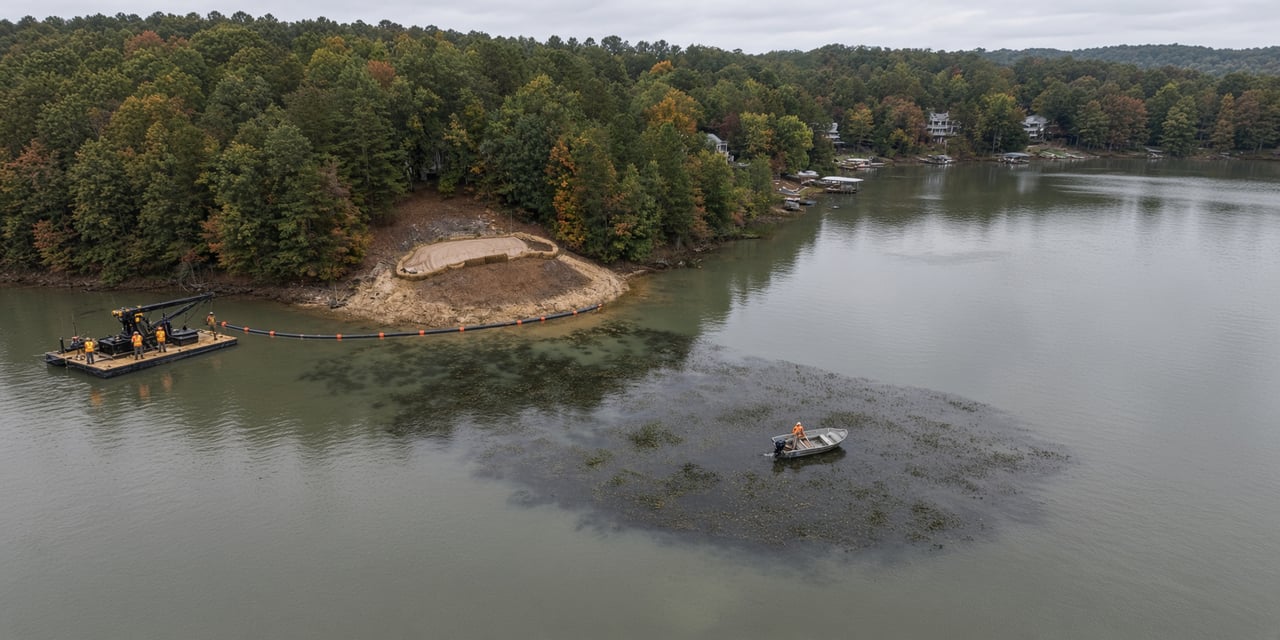
Dredging is removing sediment that has settled on the lake bottom, usually at a boat slip or along a dock, to get water depth back. Coves fill in slowly and quietly. Creeks and rain carry soil into the lake, it drops out where the water is calm, and the back of a cove collects it first. A slip that floated a boat comfortably when the house was built can be a foot shallower twenty years on. Owners dredge to float a boat again, to use a lift, or to keep a clean run out to open water.
Hydrilla is an invasive submerged plant that grows fast in warm, shallow water. It is seasonal, it shows up through the summer, and it is why a cove can look different in August than it did in June. Lake Anna has been managing it since the 1990s and there is an established program behind it.
They look like one thing from the end of a dock. They are two, each with a well-worn path, and both get done here every year.
Dredging: Dominion, then the state, then Dominion again
The order is the main thing to know, because it runs differently from the rest of this series. You write to Dominion Energy asking permission. Dominion sends you to the state for a Joint Permit Application. Once that comes back approved, Dominion issues the Construction and Use Agreement that lets you start.
For a dock, or the bank and beach work in Part 6, Dominion goes first and the county follows. For a dredge, the state sits in the middle. Knowing that upfront is most of the battle, because it tells you when to start.
Your submission needs a dredging method, drawings of the area, the volume to be removed, drawings of the disposal pit, your contractor's details and a copy of your deed. Your contractor will have to carry insurance naming Dominion as an additional insured. The full specification is Section VIII of Dominion's Construction and Use Agreement.
One wrinkle before you follow those instructions literally. Dominion's document sends applicants to the Virginia Department of Environmental Quality for the Joint Permit Application. Since September 2025 the US Army Corps of Engineers has been the central point of receipt in Virginia, and the Virginia Marine Resources Commission says the Regulatory Request System is the only way to submit one. Ask the Reservoir Coordinator what Dominion now accepts as proof of state approval.
October 1 to March 15, and one year on the clock
Dredging at Lake Anna is allowed only between October 1 and March 15, and the work must be finished within one year of permit issuance. Both limits come from Dominion's agreement.
That is a five and a half month season, which means permitting has to be done before it opens. Start the paperwork in October and you are realistically working next winter.
It is not a drawdown window, whatever you hear locally. Dominion publishes no scheduled drawdown at Lake Anna. Levels do run lower in fall, which is how most owners find the problem, but that is weather and operations. Dominion listed the lake at 248 feet on November 2, 2026, against a normal range it gives as 249 to 251. We covered what actually moves the lake in our water level update.
Why the state step is worth starting early
Virginia's general permit for minor water impacts, the one that covers most small shoreline projects under half an acre, does not cover dredging. So a dredge gets handled on its own terms rather than slipped under a routine approval, even when the area is small.
That is not a hurdle so much as a scheduling fact. It is also the reason to make the state your first call rather than your last, and the agencies are used to the question. They will tell you which approval your project needs and whether the Army Corps has a role at Lake Anna, which is a genuinely open question that gets answered parcel by parcel.
Where the spoil goes
Dominion requires the disposal pit to sit above the flood stage line, and it must remain undisturbed afterward without prior permission. That second condition is permanent and easy to miss.
Then the county, because a spoil pad is land disturbance, and the three thresholds differ:
- Louisa County: 10,000 square feet. Louisa is also the only county with a Lake Anna shoreline ordinance, and on dredging it defers to Dominion's standards.
- Spotsylvania County: 2,500 square feet, because the whole county is a Chesapeake Bay Preservation Area. Its ordinance names dredging in the definition of land disturbance, and a spoil pad inside the 100-foot Resource Protection Area buffer can trigger a water quality impact assessment.
- Orange County: 10,000 square feet, reduced to 2,500 on residentially zoned property. Nothing specific to dredging or spoil.
An acre or more in any of the three brings in state stormwater coverage. That is not theoretical: the one documented Lake Anna dredge put its spoil on about an acre.
What it costs
One published record exists, and it is eight years old. In 2018 the Southwind Shores I community in Spotsylvania County moved about 2,600 cubic yards at a bid of roughly $100,000, including about $8,000 for permitting. That is about $50 per cubic yard, and each homeowner paid a $4,000 special assessment. The work ran fall into spring, inside Dominion's window.
Treat it as a reference point, not a quote. No published figures exist for how long permitting takes here.
Hydrilla: who decides, and it is not your county
Two bodies run this, split by which water you are on. On the public reservoir, the Lake Anna Advisory Committee surveys the lake, scores priority areas, writes the annual plan and procures the contractor, with Dominion making the final call on any treatment. On the Waste Heat Treatment Facility, the private side, Dominion Energy is solely responsible for management and funding.
Behind them sit three state agencies in narrow roles: the Virginia Department of Wildlife Resources approves which products may be used and permits grass carp stocking, DEQ covers the discharge, and the Virginia Department of Agriculture and Consumer Services licenses applicators. Your county is a funder, not a regulator.
Scale, from the committee's 2026 treatment plan dated January 22, 2026: 410.55 watch-list acres lake-wide, including 146.25 on the private side, against a $30,000 budget. Watch-list acres are not the same as acres of dense growth, and 2026 survey results had not been published as of the committee's August 27 meeting. For historical scale, 832 acres were measured in 1994.
How to get your dock area treated
The treatment itself goes through Dominion and a licensed applicator rather than through you, and the request is free to make. Dominion's vegetation policy works with two methods: sterile grass carp, or an approved herbicide.
On the public reservoir, send the request form to the committee with photos or a map. If it is approved, you contract directly with the committee's awarded contractor. Owners, groups of neighbors and HOAs can fund a treatment themselves and still use that contractor, and a privately funded area can be approved even when it falls below the committee's own priority thresholds. Requests close October 1 for the following year's plan, so an August request is aiming at next summer.
Know what an individual approval covers before you picture the result. It is aimed at access: from your property to your dock and out to the main water body, including a cleared lane of up to 10 feet beside the dock. Approvals are granted case by case rather than standing year to year, which is why the October request goes on the calendar as an annual item.
One update for private-side owners. On the Waste Heat Treatment Facility, Dominion now handles treatment directly rather than through privately funded jobs. Report growth to the committee's private-side address and it goes onto Dominion's schedule. That changed for the 2026 season and some pages online still describe the old route.
Why nobody rakes it out
This is the most useful thing to know about the plant. Hydrilla spreads by fragmentation, so a rake, a cutter or a prop breaks it into pieces, each piece drifts, and each piece can take root somewhere new. Clearing it by hand tends to spread it.
Louisa County's guidance advises against mechanical removal in the lake or the Waste Heat Treatment Facility, and the 2026 protocol records that the committee, Dominion and the Department of Wildlife Resources all take the same view. Which is good news for a Saturday: the approach that works is the one where somebody else does it.
Frequently asked questions
Do I need a permit to dredge at my own dock at Lake Anna?
Yes. Dredging at Lake Anna is approved by Dominion Energy through a Construction and Use Agreement, and Dominion's published process has the state Joint Permit Application approved first. Virginia's general permit for small water impacts does not cover dredging, so a dredge is reviewed on its own terms rather than under a routine shoreline approval. If the spoil goes on the ground, a county land disturbance permit may also apply.
When can you dredge at Lake Anna?
Dredging is allowed only between October 1 and March 15, and the work must be finished within one year of permit issuance. Both limits come from Dominion Energy's Construction and Use Agreement. Because permitting has to be complete before the window opens, an owner beginning the process in the fall is usually working the following winter rather than the current one.
Can I spray or pull hydrilla in front of my own house at Lake Anna?
The treatment runs through Dominion Energy rather than through you. Dominion owns the reservoir and approves treatment, and on the public reservoir the work is done by the contractor the Lake Anna Advisory Committee has under contract, using a product approved by the Virginia Department of Wildlife Resources and applied by a licensed applicator. Raking or cutting it yourself is advised against, because hydrilla spreads by fragmentation and clearing it by hand tends to spread it.
Who do I call about hydrilla at Lake Anna?
For the public reservoir, the Lake Anna Advisory Committee's hydrilla request address, with photos or a marked map. For the Waste Heat Treatment Facility, the committee's private-side address, which routes the report to Dominion Energy. Dominion's North Anna Reservoir Coordinator can be reached at [email protected] or 540-894-2307. Your county has no regulatory role in hydrilla.
What does it cost to dredge at Lake Anna?
There is one published record. A 2018 community project at Southwind Shores I in Spotsylvania County moved about 2,600 cubic yards at a bid of roughly $100,000, including about $8,000 for permitting, which works out to about $50 per cubic yard. Each homeowner paid a $4,000 special assessment. That is one job from 2018 and should not be treated as a current rate.
Does Lake Anna have a winter drawdown for shoreline work?
No scheduled drawdown is published. Lake levels do run lower in fall and winter, which is when most owners notice a silted slip, but Dominion attributes seasonal lows to weather and operations rather than a planned drop. Dominion gives the normal range as 249 to 251 feet above mean sea level and listed the lake at 248 feet on November 2, 2026. The October 1 to March 15 dredging window is a permit condition, not a drawdown schedule.
Where to start
For either problem, Dominion's North Anna Reservoir Coordinator, [email protected] or 540-894-2307.
For hydrilla, add the Lake Anna Advisory Committee, before the October 1 cutoff. For dredging, add DEQ and the Corps early, because that step sits in the middle of Dominion's process. Add your county only if spoil is going on the ground.
Neither of these is an unusual request. The committee treats dozens of areas a year, Dominion processes these agreements routinely, and coves around this lake get dredged every winter. Ask early, and both are ordinary maintenance on a working lake.
Please verify before you act on it. This reflects the best research we could do as of November 2026, from Dominion Energy's Construction and Use Agreement and aquatic vegetation policy, the Lake Anna Advisory Committee's 2026 plan, protocol and meeting packets, Virginia DEQ and Army Corps materials, and county sources, all linked above. Some of it is genuinely unsettled in anything published, including whether federal jurisdiction reaches Lake Anna and which state permit covers a residential dredge, and we have said so rather than filling the gaps. Dominion's agreement carries no revision date and still describes a state submission process that changed in September 2025. Hydrilla plans are rewritten each winter, so confirm the current season's protocol. Your HOA covenants may add requirements none of this covers.
What we are and are not. The M Group is a real estate brokerage. We are not a law firm, an engineering firm, a marine contractor, a licensed pesticide applicator or a permitting authority. Nothing here is a legal opinion or an engineering judgment, no agency or company named has reviewed or endorsed it, and we disclaim warranties and liability for decisions made from it. It is a starting point for better questions.
The Lake Anna Waterfront Rules series
Part 1: The Dominion Easement at Lake Anna: What It Really Is
Part 2: How Big a Dock Can You Build at Lake Anna, Virginia? (2026)
Part 3: Does a Lake Anna Dock Convey With the House?
Part 4: Can You Run Power and Water to a Lake Anna Dock? (2026)
Part 5: Can You Cut Trees on the Lake Anna Shoreline? (2026)
Part 6: Can You Build a Sand Beach at Lake Anna? (2026)
Part 7: Can You Dredge a Silted Slip or Treat Hydrilla at Lake Anna? (this article)
Part 8: Who to call, and in what order
Next in Part 8: every approval in this series in one place, the order they go in, and who answers the phone.
Buying or selling waterfront at Lake Anna?
Send us the address and we will tell you what we know about that stretch of water: what it does at the dock through the season, and whether the cove has treatment history behind it.
Talk to us about buying at Lake Anna, or get a straight answer on what your waterfront is worth.
We are on this water every week and we are happy to answer a question without a listing attached to it.
Michael Boyce II, Real Estate Professional
The M Group, Real Broker, LLC
540-870-0437
[email protected]
www.themgroupva.com
Melanie Lucero, Real Estate Professional
The M Group, Real Broker, LLC
540-870-0714
[email protected]
www.themgroupva.com
Want the lake in your inbox? The Lake Life Briefing goes out weekly with lake levels, what is happening around the water, and new listings. Sign up here.
